



Ahlem Mahroua is the founder of nova*, a Marketing Advisory Studio helping founders and premium B2B firms become easier to find, trust, and choose. She has 20+ years of operator experience and has advised 400+ founders and enterprise boards across the GCC and Europe, including through Hub71, Sheraa, Plug and Play, and Techstars.
Connect with Ahlem Mahroua on LinkedIn.
Table of Contents – How to Evaluate If Your Business Ideas Are Actually Worth Pursuing: A 7-step Framework for Founders
You have an idea for a business. You actually have many business ideas.
Maybe it’s something you’ve been thinking about for months. Maybe it came to you last week. Maybe it’s solving a problem you experienced yourself, or filling a gap you noticed in the market.
Most founders get stuck at the same place: How do you actually know if the idea is worth pursuing?
Because here’s what happens. You tell your friends, they say it’s great. You do some research online, find 10 competitors, and suddenly you’re not sure anymore. You crunch some numbers, estimate the market size, and it looks big enough. But then you ask yourself: “Is it actually big enough for me? Will this really work? Should I actually do this?”
And then you’re stuck in analysis paralysis.
The honest truth: most people don’t have a framework for evaluating business ideas. So they go with gut feel, or they ask their network, or they get excited about the revenue potential and ignore the execution reality.
That’s exactly how bad business decisions get made.
A strong business idea isn’t just something that sounds good. It’s something that works for your specific situation, your skills, your network, and your financial runway. The same idea can be brilliant for one founder and a disaster for another.
So I’m going to give you a framework to evaluate whether a business idea is actually worth your time. Not just whether it could work theoretically. Whether it makes sense for you to pursue it right now.
Why Most Founders Get This Wrong
Before we get into the framework, let’s talk about why so many founders waste time on ideas that don’t deserve it.
Usually it’s one of three reasons:
1. They fall in love with the problem, not the solution
You identify a real problem. Founders need better marketing structure. Event planners waste time on scheduling. Restaurant owners struggle with inventory. All real problems.
But a real problem doesn’t mean a viable business. You need a solution that customers will actually pay for, at a price that makes sense, in a way they can actually buy it. Most founders skip this step and jump straight to “the market needs this” without checking if the market will actually buy it.
2. They confuse market size with opportunity
The event planning software market is worth $8 billion globally. That sounds huge. So founders think: “If I capture even 1% of that market, I’m a billionaire.”
But 1% of a $8 billion market is impossible for a solo founder or small team. And even 0.1% requires competing with established players, huge marketing budgets, and years of execution.
The right question isn’t “How big is the market?” It’s “How much of this market can I realistically capture with my resources, skills, and time?”
3. They ignore the execution gap
An idea is one thing. Executing it is another. Most founders underestimate:
- How long it takes to build (or source) the product
- How hard it is to find and convince customers to buy
- How much capital you need to stay alive while building
- How much competition you’re actually facing
- How different the market reality is from your assumptions
A good framework forces you to think through execution, not just the idea itself.
The honest truth: most people don’t have a framework for evaluating business ideas. So they go with gut feel, or they ask their network, or they get excited about the revenue potential and ignore the execution reality.
Ahlem Mahroua, founder nova* growth studio
That’s exactly how bad business decisions get made.
The Framework: 7 Questions That Actually Matter
Here’s what I recommend founders use to evaluate whether an idea is worth pursuing.
It’s not complicated. But it’s specific. And if you can answer these questions honestly, you’ll know whether your idea is actually viable.
Question 1: Do you have (or can you get) unfair advantage?
The best business ideas aren’t the ones with the biggest markets. They’re the ones where you have an unfair advantage—something competitors don’t have or can’t easily copy.
This could be:
- Deep expertise in the industry (you’ve worked in it for 10 years)
- Existing relationships and network (you know 500 potential customers personally)
- Unique insight into the problem (you experienced it yourself)
- Technical capability others don’t have (you can build something they can’t)
- Geographic arbitrage (you understand a market others don’t)
If you don’t have at least one unfair advantage, the idea is probably harder than you think. Because you’ll be competing head-to-head with established players and other founders who are equally hungry.
The honest question: What do you have that a smart competitor couldn’t replicate in 6 months?
If the answer is “nothing” or “I’ll just work harder,” the idea needs more thought.
Question 2: Can you acquire customers in a way that actually works?
This is where most business ideas die.
You have a great product. But how do you actually get customers to buy it? Not theoretically. Specifically. For your business.
Will you sell to them directly? Are you going to cold email? Will they find you on Google? Can you build an audience on LinkedIn? Will you go to events and talk to people?
The critical thing: the customer acquisition channel has to exist for your specific idea, and you have to be able to execute it.
A lot of founders invent ideas based on what seems cool, then realize they have no idea how to actually reach customers. “I’ll build a great product and word-of-mouth will take care of the rest” is not a go-to-market strategy.
The honest question: How will your first 10 customers find you? And then your first 100? Is that repeatable?
If you can’t answer that specifically, the idea is incomplete.
Question 3: Is the unit economics actually viable?
This is the math question. And a lot of founders don’t want to do the math.
But it matters. Because you can have a great idea with terrible economics, and it will never be a real business.
Unit economics means: How much does it cost you to acquire a customer? How much do they pay you? How long do they stay? What’s your gross margin?
Let’s say you’re building a B2B SaaS tool. You estimate:
– Customer acquisition cost: $5,000
– Annual contract value: $2,000
– Average customer lifetime: 2 years
– Gross margin: 70%
So you’re spending $5,000 to acquire a customer who pays you $4,000 (2 years × $2,000), but you keep 70% of that ($2,800). That’s a loss. This idea doesn’t work.
Now adjust it:
– Customer acquisition cost: $2,000
– Annual contract value: $5,000
– Average customer lifetime: 3 years
– Gross margin: 75%
Now you’re spending $2,000 to acquire a customer who pays you $11,250 (3 years × $5,000), and you keep 70% ($7,875). That’s viable.
The honest question: Can you make money on each customer, or do you need infinite scale to break even?
If you need 10,000 customers to break even, that’s a different risk profile than if you need 50.
Question 4: Do you have (or can you get) the capital to survive until profitability?
Most good ideas fail because the founder ran out of money before the business took off.
This is where you need to be honest about runway. How many months can you survive without revenue? 6 months? 12? 24?
Then ask: Based on realistic customer acquisition, how long until this business generates enough revenue to cover operating costs?
If the answer is “12 months to break even” but you can only survive 6 months without revenue, you have a gap. That gap is either filled with capital (your own savings, investors, loans) or the idea needs to change.
The honest question: Can you fund this business until it becomes profitable? Or do you need external capital, and how realistic is that?
Question 5: Are you the right person to build this, or is someone else better positioned?
This is the one founders skip most often.
Just because you have an idea doesn’t mean you’re the right person to execute it. Maybe the idea is good, but someone else has more relevant experience, better connections, or more time to dedicate.
Or maybe you have the idea, but your co-founder is better positioned to lead it while you focus on sales or operations.
The question isn’t just “Is this a good idea?” It’s “Am I the right person to make this idea successful?”
If the answer is “maybe, but someone else would probably be better,” that’s important information. It doesn’t kill the idea. But it means the execution path is different.
The honest question: What would make someone else better positioned than me? Do I have those skills, or can I learn them fast enough? Or should I partner with someone who has them?
Question 6: Does this idea align with where you want your life to go?
This is the one that saves founders years of wasted time.
You can have a brilliant idea with great unit economics and a clear customer acquisition path. But if executing it requires you to:
- Work 80-hour weeks for the next 3 years
- Move to a different country
- Give up your family time
- Build something you don’t actually care about
Then it’s not the right idea for you. No matter how viable it is on paper.
The honest question: Will building this business give me the life I want, or just the revenues I want?
Question 7: What’s the realistic timeline to validate this idea?
You don’t need to have all the answers before you start. But you should have a plan to test your assumptions quickly.
Can you validate the core assumption in 30 days? 90 days? 6 months?
Most ideas have one or two critical assumptions: – Will customers actually buy this? (Can you presell 10 units?) – Can you deliver this profitably? (Can you build a prototype that works?) – Is the market big enough? (Can you find 100 people who have this problem?)
The timeline to validate these assumptions tells you how long you need to commit before you know if the idea works.
The honest question: What’s the quickest, cheapest way to prove or disprove my core assumptions?
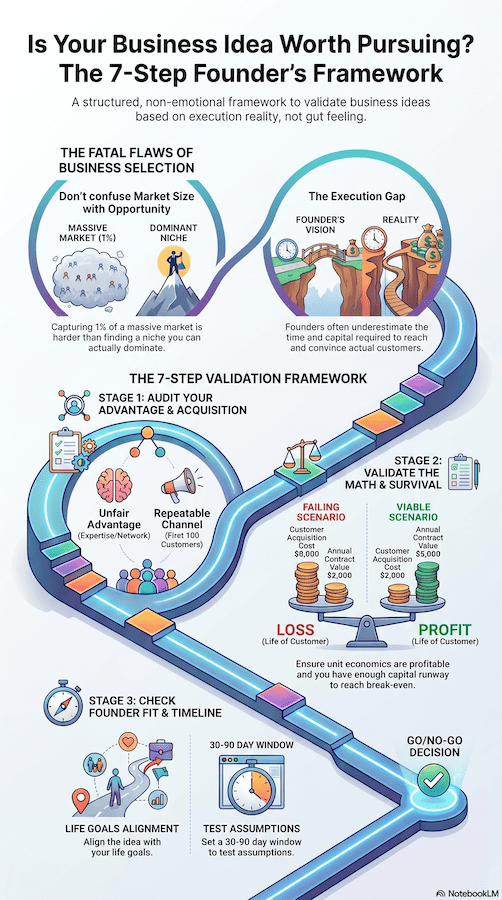
Putting It Together: The Decision
Once you’ve answered these seven questions honestly, you should have clarity.
If you have:
- An unfair advantage
- A customer acquisition path that works
- Viable unit economics
- Enough capital to survive the timeline
- You’re the right person
- It aligns with your life goals
- A way to validate quickly
Then you have a business idea worth pursuing.
If you’re missing more than 2-3 of these, the idea either needs work, or it’s not the right time for you to pursue it.
That doesn’t mean the idea is bad. It just means the conditions aren’t right. Maybe next year they will be. Maybe someone else should pursue it. That’s okay.
The Structure Problem (And Where nova* Comes In)
Here’s what I see most often: founders have great ideas that check most of these boxes. They know the market. They have some capital. They can reach customers.
But they don’t have clarity on:
- Which customers to prioritize first
- How to actually position this idea in the market
- What the go-to-market strategy should look like
- How to structure the sales and marketing so it scales
- What metrics actually matter
- How to prioritize the first 90 days
That’s where a lot of good ideas die. Not because the idea wasn’t viable. Because there was no structure around execution.
This is exactly what I help founders do through my paid consultation service. We take an idea you’ve already validated (or are about to validate), and we build the commercial structure around it. Customer positioning. Go-to-market strategy. Marketing and sales alignment. Revenue targets and roadmap.
If you have a business idea that’s checked most of the boxes in this framework, but you’re not sure how to actually structure the go-to-market and find your first customers, let’s talk about a paid consultation. We can spend an hour going deep on your specific idea, your market, your positioning, and what your first 90 days should actually look like.
Cost is $250/hour. And most founders find the clarity is worth 10x that.
If you have a business idea that’s checked most of the boxes in this framework, but you’re not sure how to actually structure the go-to-market and find your first customers, let’s talk about a paid consultation.
Let’s talk today.
We can spend an hour going deep on your specific idea, your market, your positioning, and what your first 90 days should actually look like.
Cost is $250/hour. And most founders find the clarity is worth 10x that.
FAQ on How to Evaluate If Your Business Ideas Are Actually Worth Pursuing: A 7-step Framework for Founders
1. I have a great idea but no unfair advantage. Should I still pursue it?
Not unless you can build one. The difference between success and failure in a crowded space often comes down to advantages competitors don’t have. But “unfair advantage” doesn’t have to be huge. It could be: you’re willing to serve an unsexy market segment nobody else wants. You have deep relationships in one industry. You’re in the right geography at the right time. Build your advantage first, then launch.
2. How do I know if my customer acquisition strategy will actually work?
Test it before you build the full product. Cold email 100 potential customers and see how many respond. Go to an industry event and talk to 20 people. Post on LinkedIn about the problem and see who engages. Pre-sell your product to 10 customers before it exists. Real customer feedback beats theoretical assumptions every time.
3. What if my unit economics work on paper but I’m not sure they’ll work in reality?
Your assumptions are probably wrong. Customer acquisition costs are always higher than you think. Customer lifetime is always shorter. Gross margins are always lower. Build in a 50% buffer on your costs and a 50% reduction on your revenue. If the idea still works, you’re onto something.
4. Should I quit my job to pursue this idea?
Not unless you’ve validated the core assumptions first. Can you get paying customers while working part-time? Can you build a prototype in your spare time? Can you get pre-commitments from customers? De-risk as much as possible before you bet your income on it. Most successful founders didn’t quit their jobs until the side business was already generating real revenue.
5. What if I’m missing one or two of these criteria?
It depends which ones. Missing customer acquisition clarity? That’s fixable—go find customers. Missing capital? Maybe you can start smaller or bootstrap longer. Missing the right co-founder? Partner with someone. But if you’re missing more than 3 major pieces (like: you have no unfair advantage, no clear way to reach customers, bad unit economics, and no capital), the idea needs rethinking.
6. How long should I spend evaluating before I start building?
2-4 weeks maximum. Get clarity on the framework, validate the core assumptions with real customers, then start building. Most founders spend too much time planning and not enough time in market. You’ll learn more in 30 days of customer conversations than 3 months of planning.
7. What if my idea doesn’t fit into this framework?
This framework is designed for business ideas you’re considering pursuing as a business (i.e., something that needs to generate revenue and scale). If you’re building something non-commercial (a side project, a hobby, a non-profit), the questions shift. But if your goal is to build a real, profitable business, these seven questions cover the core decisions.