



Ahlem Mahroua is the founder of nova*, a Marketing Advisory Studio helping founders and premium B2B firms become easier to find, trust, and choose. She has 20+ years of operator experience and has advised 400+ founders and enterprise boards across the GCC and Europe, including through Hub71, Sheraa, Plug and Play, and Techstars.
Connect with Ahlem Mahroua on LinkedIn.
Table of Contents for Marketing Strategy for Founders
Most founders, CEOs, and managing partners make marketing strategy more complicated than it needs to be.
They ask, “What is our marketing strategy?” and within five minutes the conversation turns into growth hackers, GTM engineers, AI funnels, outbound automation, content engines, paid ads, CRM dashboards, and some extremely ambitious Notion system that nobody will maintain after week three.
I understand the temptation, because complex systems feel serious, especially when you are trying to build something ambitious.
But after 20+ years as an operator and Fractional CMO, and after advising 400+ founders and enterprise boards, I keep seeing the same pattern:
the companies that make marketing work are not always the ones with the most sophisticated stack. They are usually the ones that do the simple work better and more consistently than everyone else.
A strong marketing strategy for founders does not start with channels, tools, or automation.
It starts with contact with the market. That means speaking to real prospects, listening to how they describe their problem, understanding what they already believe, hearing why they hesitate, and noticing which parts of your offer make them lean forward.
This is not the glamorous part of marketing, and it rarely looks impressive on LinkedIn. Nobody wants to post, “I had 17 slightly awkward conversations this week and learned that my positioning is wrong.”
But that kind of work is often the difference between marketing that sounds clever internally and marketing that actually creates revenue.
The simplest definition I use is this: marketing is getting the right message in front of the right decision-makers often enough until they trust you.
That is true whether you are an early-stage startup trying to find your first 100 users, a founder-led consultancy trying to attract better clients, or a premium B2B firm trying to win a high-value enterprise deal. The scale changes, the sales cycle changes, the content formats change, but the fundamentals do not.
You still need to know who you are trying to reach, what they care about, why they should trust you, and what makes choosing you feel lower-risk than doing nothing or choosing someone else.
What is marketing strategy for founders?
Marketing strategy for founders is the process of understanding the market, sharpening the message, making proof visible, and reaching the right decision-makers consistently enough to build trust.
It is not simply a channel plan, a content calendar, or a funnel.
For founder-led businesses, marketing strategy should answer five practical questions:
- who are we trying to reach,
- what do they care about,
- what should they trust us for,
- where do they already pay attention,
- and what action should our marketing create?
The companies that make marketing work are not always the ones with the most sophisticated stack. They are the ones that do the simple work better, closer to the market, and more consistently than everyone else.
Ahlem Mahroua
The mistake: building the marketing machine before understanding the market
The most common mistake I see is sequencing.
Founders want to scale awareness and acquisition before they have enough evidence that their message actually lands. They want more content before they know what their buyer needs to hear. They want outreach automation before they know which opening line gets a real reply. They want a funnel before they understand the objections sitting between interest and action.
This creates a very expensive kind of noise: more campaigns, more posts, more dashboards, more activity, but not necessarily more trust.
The unsexy truth is that many marketing problems are really market-contact problems.
- If your website does not convert, it may not be because the page design is weak; it may be because the promise is unclear.
- If your LinkedIn content gets polite likes but no serious inbound, it may not be because the algorithm hates you; it may be because the content does not make a buyer feel understood.
- If your outbound is ignored, it may not be because your sequence is too short; it may be because the message is not attached to a problem your buyer recognizes as urgent.
Before you scale a content engine, hire an agency, or build a 47-step AI funnel, ask a simpler question: how many actual prospects have you spoken to this week? Not friends. Not mentors. Not people who vaguely “love the idea.” Actual buyers, users, clients, budget holders, decision-makers, or operators close enough to the problem to tell you the truth.
If the answer is zero, the strategy probably does not need more complexity. It needs more reality.
| Overcomplicated Marketing | Market-led Marketing |
|---|---|
| Starts with tools | Starts with buyer conversations |
| Builds funnels before message clarity | Tests language before scaling |
| Measures activity | Measures buyer response |
| Produces content | Builds trust |
| Scales assumptions | Scales what has been validated |
| Hires for growth too early | Clarifies positioning first |
Marketing strategy for founders is mostly message, market, and trust
When people say “marketing strategy,” they often imagine a large document with channels, personas, campaigns, budgets, KPIs, content calendars, tech stacks, dashboards, and competitive analysis.
Those things can be useful, especially as a company grows, but they are not the core of the strategy. At founder stage, and even in many premium B2B environments, the strategy is usually much simpler than that.
At its core, you need to answer three questions:
- Who exactly are we trying to reach, and who has the power to care, influence, recommend, or buy?
- What message makes them understand the problem, trust our expertise, and believe our approach is worth considering?
- How do we put that message in front of them often enough, through the right mix of conversations, content, referrals, search, partnerships, and sales activity?
This is why founder-led conversations matter so much. A good prospect conversation gives you the raw material for everything else: website copy, B2B positioning and online presence, LinkedIn posts, case studies, sales decks, email angles, FAQ sections, pricing logic, and even product decisions.
The words your buyers use are often better than anything a marketing team could invent in a room. Their objections show you what your content needs to address. Their confusion shows you where your positioning is weak. Their urgency shows you what your offer should emphasize.
The invisible work that makes marketing work
The real work of marketing often looks embarrassingly manual. It is not always the beautiful strategy deck or the polished campaign launch.
It is the founder asking for 50 warm introductions, sending 100 highly targeted one-to-one messages, following up with people who went quiet, interviewing five prospects who do not understand the offer, and paying attention when one serious buyer says, “Actually, we need this now.”
That work can feel slow because it is not scalable at first, but it creates the information you need before you scale.
This is the work I would rather see founders do before investing in complicated marketing infrastructure:
- Have 20 to 30 direct conversations with people who match the buyer profile you think you want.
- Ask them what they have already tried, what failed, what they are under pressure to fix, and what would make them trust a provider.
- Listen for repeated language, not just compliments, because repeated language is usually where positioning lives.
- Test three versions of your message in conversations before turning one into website copy or a campaign.
- Build a simple proof bank with client outcomes, objections, screenshots, testimonials, before-and-after moments, and stories from delivery.
- Turn what you learn into one clear website, one credible LinkedIn presence, one simple sales narrative, and one repeatable outreach motion.
This is not anti-technology. This is pro-sequencing.
Once you understand the market, tools become useful. AI can help you structure notes, summarize interviews, extract themes, draft content, repurpose insights, and build a content system.
But AI cannot tell you what your buyer actually cares about if you have not done the work of listening. It can only multiply the quality of the input you give it.
A simple marketing strategy for founders
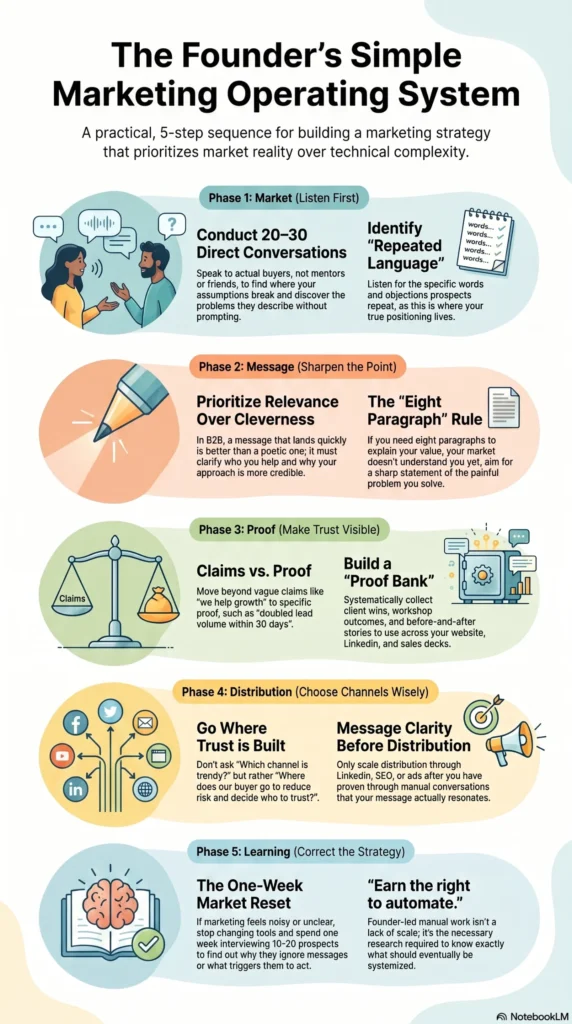
If I had to simplify marketing strategy for founders into one practical operating system, I would use this sequence:
market → message → proof → distribution → learning.It is not fancy, but it works because it forces you to build from reality instead of assumption.
I call it The Market-Message-Trust Flywheel™
- Market: speak to the people you want to influence.
- Message: turn buyer language into positioning.
- Proof: make trust visible.
- Distribution: choose channels after the message is clear.
- Learning: let the market correct the strategy.
1. Market: speak to the people you want to influence
Start by getting closer to the market than your competitors are willing to get.
For startups, that means users, prospects, failed trials, lost deals, investors, partners, and people who should care but do not.
For premium B2B firms, it means decision-makers, procurement influencers, past clients, strategic partners, and the people who quietly shape trust before the official sales conversation happens.
The goal is not to “validate” what you already believe. The goal is to find out where your assumptions break.
- What problem do buyers describe without prompting?
- What words do they use?
- What do they compare you to?
- What makes them hesitate?
- What would make them act faster?
- Which trigger creates urgency?
- Which proof makes them trust you?
These answers are the foundation of your marketing strategy.
2. Message: turn market language into positioning
Once you have enough conversations, your message should become sharper. Not more clever, sharper. A clear message should make the right buyer understand what you do, why it matters, why now, and why you.
If you need eight paragraphs to explain your value, your market probably does not understand you yet.
A useful positioning statement does not need to be poetic. It should clarify:
- Who you help.
- What expensive or painful problem you solve.
- What outcome you help create.
- Why your approach is different or more credible.
- What proof supports the claim.
This is where many founders overcomplicate the work. They try to sound innovative before they sound useful. They try to differentiate through language before they have earned clarity.
In B2B, cleverness rarely beats relevance. Your buyer is busy, skeptical, and surrounded by options. The message has to land quickly.
3. Proof: make trust visible
Marketing becomes stronger when it is built on proof instead of claims.
- Saying “we help companies grow” is a claim. Saying “we helped two early-stage founders clarify their positioning, rebuild their B2B sales websites, and double their lead volume within 30 days of publishing” is proof.
- Saying “we build authority” is a claim. Showing that founders who applied your authority-building advice grew 2.4x faster than those who did not is proof.
Founders often underuse proof because it is scattered across emails, conversations, proposals, decks, and memory.
A simple proof bank can change that. Collect client wins, workshop outcomes, testimonials, buyer objections, before-and-after examples, founder stories, specific numbers, and moments where your work created clarity.
Then use that proof everywhere: on your website, in your LinkedIn content, in sales decks, in outreach, in proposals, and in follow-ups.
4. Distribution: choose channels after the message is clear
Only after you have market insight, message, and proof should you worry seriously about channels.
LinkedIn may be right. SEO may be right. Referrals may be right. Partnerships may be right. Events may be right. Direct outreach may be right. Paid acquisition may be right.
The answer depends on where trust is built in your market.
This is why “Which channel should we use?” is often the wrong first question.
A better question is: where does our buyer go when they are trying to understand this problem, reduce risk, and decide who to trust?
- For some founders, that means founder-led LinkedIn content and warm introductions.
- For others, it means search-led articles, industry reports, podcasts, partnerships, or niche events.
The right channel is the one that puts a credible message in front of the right decision-makers at the right moment in their buying process.
5. Learning: let the market correct the strategy
A good marketing strategy is not a document you write once and defend forever. It is a set of assumptions you keep testing. Every sales call, content comment, inbound lead, lost deal, referral, and objection tells you something. The question is whether you are listening.
Your market will tell you if your message is too broad. It will tell you if your offer is not urgent enough. It will tell you if buyers do not believe the outcome. It will tell you if your proof is weak. It will tell you if the problem is real but the audience is wrong.
The more disciplined you become at turning market feedback into better positioning, better content, and better offers, the less you need to hide behind complexity.
Where complexity is useful, and where it becomes avoidance
Complexity is not always bad.
- A complex B2B sale needs careful orchestration.
- A company with multiple segments needs clear messaging architecture.
- A founder-led business with a growing team needs content systems, CRM discipline, reporting, and eventually a more robust marketing operation.
Complexity is useful when it helps you think better, coordinate better, and make better decisions.
It becomes dangerous when it helps you avoid the work that feels uncomfortable.
If you are building dashboards instead of speaking to prospects, that is avoidance. If you are creating a huge content calendar before you know what your buyers care about, that is avoidance. If you are automating outbound before you know which message gets a human reply, that is avoidance. If you are hiring a specialist to scale a strategy that has not been proven manually, that is avoidance dressed as sophistication.
The founder’s job is not to do everything manually forever. The founder’s job is to stay close enough to the market long enough to know what should be systemized.
You earn the right to automate after you understand what works.
What to do this week before adding more marketing complexity
If your marketing feels noisy, unclear, or overbuilt, do not start by changing tools. Start with a one-week market reset.
Choose 10 to 20 people who represent your real market: prospects, past clients, lost opportunities, partners, or people who match the decision-maker profile you want to influence.
Ask for short conversations. Keep the agenda simple. You are not pitching; you are learning.
Ask questions like:
- When this problem comes up, what usually triggers it?
- What have you already tried?
- What makes this hard to solve internally?
- What would make you trust an external partner?
- What would make you ignore a message about this?
- What would make you say, “We need this now”?
- What language would you use to describe this problem to your team?
After those conversations, review your website, LinkedIn profile, sales deck, outreach messages, and content. If the language does not match what buyers actually said, change it. If the proof does not answer their doubts, strengthen it. If your offer does not connect to an urgent problem, sharpen it.
That is marketing strategy in practice.
The simple truth
Marketing is not that complicated. It is just easy to make complicated because the simple version requires courage, patience, and direct contact with reality. It is easier to build a funnel than hear that your positioning is unclear. It is easier to publish more content than ask whether the content is making anyone trust you. It is easier to hire someone than admit you do not yet know what message the market needs to hear.
But the companies that win are not always the ones with the most impressive system. They are the ones that understand their buyers more deeply, communicate more clearly, show proof more consistently, and stay visible long enough to become trusted.
- Before you scale your marketing, speak to the market.
- Before you hire for growth, clarify the message.
- Before you automate distribution, test the conversation.
- Before you publish more, ask whether your content makes the right buyer understand, trust, and choose you.
If your marketing, website, and content are not making you easier to find, easier to trust, and easier to choose, this is the fractional marketing advisory for founders work we do at nova*.
We help founders and premium B2B firms clarify their positioning, sharpen their message, and build marketing systems that turn real market understanding into trust.
Talk to nova* about your marketing strategy
FAQ on Marketing Strategy for Founders
What is a good marketing strategy for founders?
A good marketing strategy for founders starts with market conversations, not tools. The founder needs to understand who they are trying to reach, what those buyers care about, what language they use, what proof they need, and what action the marketing should create. Once that is clear, channels like LinkedIn, SEO, partnerships, referrals, outbound, or paid acquisition become much easier to choose.
Why do founders overcomplicate marketing strategy?
Founders often overcomplicate marketing strategy because complex systems feel more serious than simple market work. It can feel easier to build a funnel, hire a specialist, or create a content calendar than to speak directly to prospects and hear that the positioning is unclear. Complexity becomes a problem when it helps the founder avoid contact with the market.
How many customer conversations should a founder have before scaling marketing?
There is no universal number, but a founder should have enough conversations to hear repeated patterns in buyer language, objections, urgency, and trust signals. As a practical starting point, 20 to 30 direct conversations with real prospects or decision-makers can reveal far more than weeks of internal brainstorming. The goal is not volume for its own sake, but repeated evidence.
What should founders do before creating a content strategy?
Before a content strategy, founders need clear positioning, buyer understanding, and proof. Content performs better when it is built from real customer questions, sales objections, case studies, and market language. Without that foundation, a content strategy usually becomes a publishing schedule rather than a trust-building system.
Is marketing strategy different for startups and B2B service firms?
The context is different, but the fundamentals are similar. Startups may need to validate demand and find their first users, while premium B2B firms may need to build credibility with senior decision-makers and long buying cycles. In both cases, marketing still comes down to the right message, in front of the right people, often enough to build trust.
When should a founder hire a marketing agency or growth specialist?
A founder should usually hire external marketing help when there is enough clarity to scale, or when they need expert support to create that clarity. If the market, message, offer, and proof are still vague, hiring someone to “drive growth” may only scale confusion. The best time to bring in support is when the founder is ready to sharpen positioning, build a credible online presence, and turn market insight into a repeatable marketing system.