



In this article, you’ll learn:
- why early-stage customer acquisition is rarely a “channel problem”
- what Seedstars x SANAD ElevateHer founders worked on during the GTM masterclass
- how a 14-day acquisition experiment helped founders move from assumptions to evidence
- what actually worked across the cohort
- why accelerators should treat GTM as a practical execution discipline, not just a strategy topic
This article is based on the “Finding Your First 100 Customers” masterclass and workshop I delivered for the Seedstars x SANAD ElevateHer programme, and the acquisition experiments founders shared during the second working session.
Table of Contents
In May 2026, I delivered a 2-part go-to-market masterclass and workshop for founders in the Seedstars x SANAD ElevateHer programme.
The topic was simple: How do you find your first 100 customers?
But the real work was deeper than that. Because most early-stage founders do not struggle with customer acquisition because they lack ideas.
They struggle because their GTM is too vague. They are trying to reach too many people, through too many channels, with too little evidence.
They think the question is:
“Should I use LinkedIn, Instagram, TikTok, WhatsApp, partnerships, referrals, paid ads, or events?”
But the better question is:
“Who exactly am I trying to reach, what problem do they care about now, and what is the fastest way to create a real conversation with them?”
That was the shift we worked on.
Not marketing at scale. Not visibility for visibility’s sake. Not more tactics.
A sharper customer hypothesis, one focused acquisition channel, and a real experiment designed to produce evidence.
The Real Shift: From Channel Confusion to Customer Evidence
One of the biggest mindset shifts in the workshop was this:
Your first customers rarely come from marketing at scale.
They usually come from proximity, trust, conversation, credibility, and persistence.
That distinction matters because early-stage founders often overestimate the role of channels and underestimate the role of specificity.
A channel does not solve unclear positioning.
A campaign does not fix a weak customer segment.
A viral post does not compensate for a problem that is not urgent enough.
So before founders selected a channel, we worked on the foundations:
- who they were selling to first
- what urgent problem they were solving
- why that customer should trust them
- where that customer already pays attention
- what action they wanted the customer to take next
That is what go-to-market really is.
Not just marketing.
The system that connects your product to the market.
Why This Workshop Mattered for Early-Stage Founders
The ElevateHer founders were working across different sectors, geographies, and business models.
Some were selling to smallholder farmers.
Some were building mobility solutions.
Some were working with government institutions.
Some were developing sustainability, logistics, agritech, food, or circular economy solutions.
But the underlying challenge was consistent:
How do we stop guessing and start learning from the market?
That is why the workshop was structured as a working sprint, not a lecture.
In the first 3-hour session, founders worked on:
- defining a sharper first customer segment
- identifying pain and buying triggers
- writing a simple GTM sentence
- selecting realistic acquisition channels
- designing one customer acquisition experiment
- committing to a 14-day sprint
In the second 3-hour session, founders came back to share:
- what they tested
- who they reached
- what happened
- what they learned
- what they would change next
The objective was not to impress the room. The objective was to produce evidence.
Because a good experiment does not need to succeed. It needs to teach you something useful.
What We Actually Worked On
This was not a generic GTM sprint session. It was designed around a simple idea:
Founders do not need more marketing noise. They need a clearer next move.
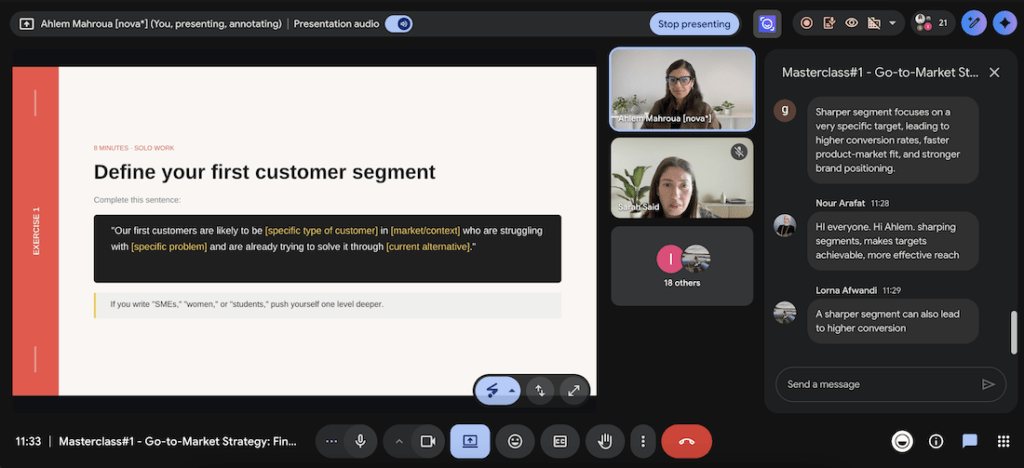
1. First Customer Segment
The first exercise focused on segment clarity. Most founders start too broad. They say they are targeting “SMEs,” “women,” “farmers,” “students,” “manufacturers,” or “businesses.”
But broad markets create vague messaging. And vague messaging creates weak acquisition.
So we pushed the founders to go one level deeper. Instead of “women entrepreneurs,” the question became:
- Which women entrepreneurs?
- In which market?
- With which urgent problem?
- Already trying to solve it how?
The goal was not to define the total addressable market.
The goal was to define a first customer segment specific enough that the founder could actually find 20 of them.
2. Pain, Urgency, and Buying Triggers
The second layer was pain. Not every customer problem is equal.
- Some problems are interesting.
- Some are frustrating.
- Some are costly.
- Some are urgent.
First customers usually move faster when the pain is already visible, costly, and urgent.
So founders worked on identifying the moment when their customer becomes more likely to act.
That could be:
- a new regulation
- a failed manual process
- a seasonal deadline
- a missed revenue target
- a public commitment
- a funding round
- a crisis or operational bottleneck
This mattered because timing is often the difference between being ignored and being relevant.
3. GTM Messaging
The third layer was messaging.
Founders were asked to write one clear GTM sentence:
“For [specific customer], we help them [achieve outcome / solve problem] without [main friction / fear / alternative pain].”This was not meant to be a final brand tagline.
It was a working sentence. Plain enough for a real customer to understand quickly. Specific enough that the customer could hear themselves in it.
This is where many founders had to simplify. Because if a sentence sounds impressive but unclear, it will not help acquisition.
4. Channel Selection
Only after the customer, pain, and message were clearer did we talk about channels.
That order matters. Channels are not magic. They are simply routes to reach the customer.
The workshop covered owned, earned, paid, direct, partnership, content, community, and referral-based channels.
But the emphasis was practical:
For early-stage founders, the best starting channels are usually the ones that create conversation fastest.
Not the ones that generate the most impressions.
That means direct outreach, warm introductions, partnerships, founder-led content, community trust, WhatsApp, field activations, and in-person meetings can often outperform paid campaigns or generic content.
Especially when the goal is to learn.
5. The 14-Day Acquisition Experiment
The final output of session one was a 14-day acquisition experiment.
Each founder had to define:
- the customer segment they would test
- the channel they would use
- the action they would take
- how many people they would reach
- what success signal they would measure
- when they would review the results
The point was not to acquire 100 customers in 14 days.
The point was to stop theorising and start testing.
- A reply is evidence.
- A rejection is evidence.
- A meeting booked is evidence.
- A pricing objection is evidence.
- A qualified lead is evidence.
- A pilot is evidence.
- Revenue is evidence.
But so is learning that the audience was wrong, the channel was weak, the message was unclear, or the product needed stronger proof.
What Happened When Founders Tested
The second session was where the real learning happened.
Founders came back with experiments across different sectors and markets.
Some produced customers.
Some produced orders.
Some produced pilots.
Some produced a pivot.
Some produced a clearer understanding of why people were not buying.
All of that mattered.
A few examples stood out.
- Biowax Ghana tested product trials with traders and farmers. Out of 30 trained traders, 18 came back to purchase after the trial. But the experiment also uncovered a blocker: the product application process was not obvious enough. Their next move was not “more marketing.” It was more demonstrations, better instructions, and working with extension officers.
- Nyamula Logistics tested WhatsApp with transporters after Facebook failed to create enough onboarding. They reached 40 transporters and onboarded 17. The insight was clear: transporters did not want another platform or a complicated process. They wanted something seamless, familiar, and fast.
- Essymart Africa tested whether smallholder farmers in new communities could adopt a digital platform for ordering agricultural inputs. They reached 25 farmers and 10 placed orders. The learning was not that digital could not work. It was that digital needed to be supported by offline activation, USSD, SMS, simpler flows, and local partnerships.
- Capapo Solutions tested recycled plastic furniture with hotels along the Kenyan coast. Emails did not work well, so the founder moved to walk-ins and site visits. From 15 hotel visits, they secured partnerships and an order opportunity, while learning that customers were more interested in customised statement pieces than standard furniture.
- Smartwatt tested demand for electric mobility conversion and discovered that the original conversion offer was not economically attractive enough for motorbike and tricycle owners. Instead of ignoring the signal, they explored another route: EV training. A workshop with 34 students revealed a potential second revenue stream.
- One founder working in solar irrigation shared a powerful acquisition insight: direct flyers and traditional field selling did not work. Local youth ambassadors did. After months of poor results, one local ambassador brought five clients in a month because farmers trusted someone from their own community.
That was the pattern across the room.
Customer acquisition improved when founders got closer to the real customer.
What Worked Across the Experiments
Several patterns repeated across the cohort.
1. Face-to-face conversations created better signal
Across multiple experiments, in-person engagement outperformed distant outreach.
- Walk-ins worked.
- Field activations worked.
- Direct visits worked.
- Physical demonstrations worked.
- Interviews worked.
This was especially true for founders selling to traditional industries, rural communities, government entities, hospitality, agriculture, logistics, or customers who needed to see, touch, test, or trust the solution before acting.
The learning was simple:
Sometimes the fastest way to acquire customers is to leave the laptop and go to the market.
2. Trust-based channels outperformed cold channels
Cold email and generic LinkedIn outreach had limits.
Warm introductions, competitions, local ambassadors, partnerships, community leaders, and existing trust networks created stronger movement.
This reinforced one of the core principles from the first session:
For first customers, trust beats reach. A WhatsApp introduction from the right partner can be more valuable than thousands of random impressions.
3. WhatsApp and familiar behaviours reduced friction
One of the clearest insights came from Nyamula Logistics. The transporters were not refusing the product. They were refusing the friction.
They did not want to move from Facebook to a platform and complete a heavy onboarding process. They wanted to send information through WhatsApp, where they already operated. That is a critical GTM lesson.
Do not force customers into your preferred process too early. Meet them where they already are.
4. Product education was part of acquisition
- For Biowax Ghana, the issue was not demand alone. It was application: Customers needed to understand how to use the product properly before they could experience the value.
- For Go to Green, the issue was not only sustainability interest. It was market readiness: Customers needed to understand why sustainability compliance mattered commercially.
- For Essymart Africa, digital adoption required digital literacy, offline support, and simpler flows.
In other words:
Sometimes the first job is not to sell the product.
It is to teach the problem, the process, or the behaviour change.
5. Strong experiments helped founders make decisions faster
The best experiments were not necessarily the ones with the biggest numbers.
They were the ones with the clearest decision rule.
- Sakan Farms tested price, delivery, and demand with a defined threshold.
- Nyamula Logistics tested channel fit.
- Bowax tested trial-to-purchase behaviour and application barriers.
- Smartwatt tested willingness to pay for one model and discovered a different opportunity.
That is what good GTM experimentation should do.
It should help founders decide whether to double down, improve and retest, or stop.
You do not need to do everything. You need to do the right next thing, measure it, and learn fast.
Ahlem Mahroua
What Did Not Work
The session also revealed repeated blockers.
1. Distance from the customer did not work
One founder put it very clearly during the session:
Customers ignore you when you stay too far away from them.
Founders cannot sit in beautiful offices and expect customers, partners, or stakeholders to come automatically.
The market needs contact. Especially in early-stage acquisition.
2. Generic outreach did not create enough trust
Cold emails, generic LinkedIn messages, and passive online outreach were weak when the buyer needed trust, proof, or relationship before acting.
This does not mean outreach is useless.
It means outreach needs sharper targeting, stronger context, and often a warmer path into conversation.
3. Assuming customers would buy by themselves did not work
A repeated assumption was quietly challenged: “If the product is good, customers will come.”
They usually will not. Interest does not convert by itself.
Founders need follow-up, conversation, proof, education, and a clear next step.
4. Digital-only approaches did not work for every market
Several founders were serving customers who were not fully online, not comfortable with digital flows, or not ready to complete the whole journey without support.
That did not invalidate the digital product. It clarified the go-to-market motion.
For some markets, digital acquisition needs offline trust infrastructure around it.
5. Free pilots without procurement clarity are risky
The government sales discussion was especially important.
Proofs of concept can be powerful acquisition tools, especially for hardware, infrastructure, energy, water, and public-sector solutions.
But a free pilot does not guarantee a paid contract.
Before investing heavily in a pilot, founders need to understand:
- who owns the budget
- who has decision power
- whether procurement is possible
- what happens if the pilot succeeds
- whether the organisation is genuinely interested or only collecting information
- how many stakeholders need to be involved
That is where stakeholder mapping becomes essential.
What Founders Left With
By the end of the two sessions, founders had not just learned a GTM framework. They had used it. They left with:
- a clearer first customer segment
- a sharper understanding of customer pain and buying triggers
- a practical GTM sentence
- a shortlist of acquisition channels
- one acquisition experiment
- evidence from the market
- peer feedback
- a clearer decision on what to do next
More importantly, they had experienced what disciplined GTM experimentation feels like.
Not guessing. Not jumping channels every week. Not hiding behind branding, content, or strategy.
Testing one focused move, measuring the signal, and deciding what comes next.
That is the difference between random activity and a growth system.
Why This Matters Beyond One Workshop
For accelerators, incubators, and ecosystem programmes, this matters.
Because founders do not need more abstract advice on customer acquisition.
They need structured practice.
They need to learn how to:
- define a specific customer
- test a channel without overbuilding
- measure meaningful signals
- interpret objections
- follow up properly
- decide what to stop, improve, or repeat
This is especially important before Demo Day, fundraising, market expansion, or grant reporting.
A founder who can say:
“We tested this segment, through this channel, reached this number of people, got this response, learned this, and now we are doing this next”
is operating very differently from a founder who says:
“We are working on marketing.”
That is the point of this kind of workshop.
Not inspiration.
Execution discipline.
Final Thought
The strongest learning from the Seedstars x SANAD ElevateHer GTM masterclass was this:
Your first customers are rarely found through more noise.
- They are found through sharper focus.
- A better customer segment.
- A more urgent pain.
- A trusted route to market.
- A clearer conversation.
- A faster experiment.
And the courage to learn from what the market actually does, not what you hoped it would do.
You do not need to do everything.
You need to do the right next thing, measure it, and learn fast.
Want to help your founders move from GTM theory to real customer evidence?
Explore how we work
I design and deliver practical growth, GTM, and founder-led acquisition workshops for accelerators, incubators, and ecosystem programmes.
The goal is simple: help founders leave with sharper thinking, practical assets, and real market-facing action.
Explore nova* workshops and ecosystem advisory, or get in touch to discuss a founder acquisition sprint for your cohort.
FAQ: GTM Sprint workshop – “Finding Your First 100 Customers“by Ahlem Mahroua
What was the Seedstars x SANAD ElevateHer GTM sprint masterclass about?
It was a practical go-to-market workshop designed to help early-stage founders identify and test their path to their first customers. The focus was not on theory alone. Founders worked on customer segmentation, pain points, buying triggers, messaging, acquisition channels, and a 14-day customer acquisition experiment.
Was this workshop about marketing channels?
Not only.
The workshop deliberately challenged the idea that customer acquisition is mainly a channel problem. Before choosing a channel, founders worked on clarifying who they were targeting, what problem mattered most, why the customer would act now, and what kind of trust was needed to start a conversation.
What was the main mindset shift in the GTM sprint masterclass?
The biggest shift was from “I need more visibility” to “I need better evidence.”
Founders learned that a good experiment does not need to succeed immediately. It needs to reveal something useful: a stronger customer segment, a clearer objection, a better channel, a pricing signal, a trust gap, or a real buying trigger.
What did founders actually do during the workshops?
They defined a first customer segment, identified buying triggers, wrote a working GTM sentence, selected acquisition channels, designed one experiment, and then came back to share what they tested, what happened, what they learned, and what they would change next.
What worked best across the founder experiments in this GTM sprint?
The strongest patterns were face-to-face conversations, warm introductions, WhatsApp, local ambassadors, field activations, product demonstrations, and partnerships. In many cases, getting physically closer to the customer produced better insight and faster traction than generic online outreach.
What did not work in this GTM sprint?
Generic cold outreach, digital-only assumptions, passive waiting, unclear follow-up, and broad customer targeting were common blockers. Some founders also learned that customers were interested but needed more education, stronger proof, a simpler process, or a clearer reason to act now.
Why is this useful for accelerators and incubators, and innovation programmes?
Because founders need more than GTM advice. They need GTM practice.
A structured acquisition sprint helps founders test real assumptions, collect evidence, and make better decisions before Demo Day, fundraising, expansion, or follow-on support.
What did founders leave with after this customer acquisition workshop?
They left with a clearer customer hypothesis, a practical acquisition experiment, real market feedback, peer insights, and a decision on whether to double down, improve and retest, or stop and try a better channel.