



Ahlem Mahroua is the founder of nova*, a Marketing Advisory Studio helping founders and premium B2B firms become easier to find, trust, and choose. She has 20+ years of operator experience and has advised 400+ founders and enterprise boards across the GCC and Europe, including through Hub71, Sheraa, Plug and Play, and Techstars.
Connect with Ahlem Mahroua on LinkedIn.
Table of Contents – Digital Marketing Platforms: Pick The Right One in 2026
Founders often ask: what are the best digital marketing platforms for small enterprises in the UAE?
It’s a reasonable question, but it’s also the wrong starting point. Before you compare tools, you need to know what your revenue model actually requires, because the UAE looks like one market but behaves like several. Arabic-speaking consumers, South Asian SME buyers, Western expat professionals, and B2B procurement teams all live here, and they respond very differently to the same channels. Picking a platform before you understand that is a reliable way to burn your first three months of ad spend learning nothing useful.
This article is a decision guide, not a ranked list. The right digital marketing tools for your UAE business depend on three things: who your buyer actually is, what budget you can sustain for a meaningful test period (typically one to three months), and whether you’re selling to businesses or consumers. Get those three answers clear, and the platform question almost answers itself.
Why the UAE is a uniquely complicated market to advertise in
A platform strategy that works in London or even Riyadh won’t automatically translate here without adjustment. The UAE isn’t a homogenous audience. It’s a multicultural, bilingual market where purchase behaviour shifts significantly based on nationality, language, and income bracket. That complexity matters more for platform selection than most founders realise.
A bilingual market where ad creative strategy changes everything
Arabic and English audiences consume content differently, even on the same platform. Based on patterns commonly observed by regional practitioners, Arabic-language creative tends to perform better with warmer, relationship-forward messaging, while English-language content often skews more direct and feature-led, though this is worth A/B testing for your specific offer.
What doesn’t change is format: visual-first content, particularly Reels and short-form video, drives higher engagement across both language groups in the GCC.
WhatsApp also functions as a dominant follow-up channel in the UAE, with adoption levels and usage patterns that differ markedly from most Western markets.
That affects how you design your full funnel, not just which ad platform you choose.
B2B vs B2C dynamics specific to the GCC
Relationship-driven selling is a well-documented pattern in GCC business culture, and it changes what “conversion” means on a digital platform. For B2B buyers especially, most platforms generate awareness and surface credibility rather than close deals. The decision to buy still happens through trust, referral signals, and direct conversations.
That’s not a reason to avoid digital advertising; it’s a reason to be precise about what you’re asking each platform to do. Reach is not the same as qualified engagement, and in the UAE, that distinction is expensive to ignore.
What are the best digital marketing platforms for small enterprises in the UAE? How the main paid options compare
Think of each platform as a tool built for a specific job. The mistake is trying to use one tool for every job in your pipeline. Here’s how the main options break down by who you reach, what it costs, and what each is actually best used for in the UAE.
Google Ads and YouTube: high intent, high reach, high stakes
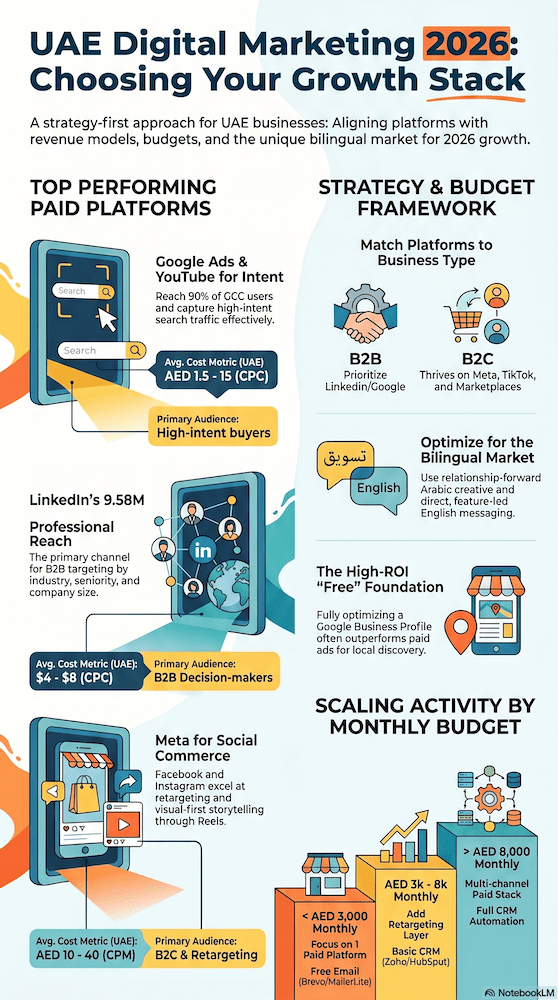
Google’s ecosystem reaches over 90% of internet users across GCC markets, making it the default choice for capturing existing demand. If someone is searching for your product or service, Google Search is where you show up.
UAE CPCs typically range from AED 1.5 to AED 15 depending on sector, based on composite benchmarks from multiple UAE digital advertising guides, and a realistic starting budget for small businesses is AED 1,500 to AED 3,000 per month for early testing.
YouTube sits inside the same ecosystem and represents the UAE’s largest online ad segment by spend, making it the strongest single platform for video-led awareness campaigns.
For recent market figures, see the online advertising market in the UAE.
Meta (Facebook and Instagram): retargeting, reach, and social commerce
Meta remains one of the most versatile platforms in the UAE because it reaches a broad cross-section of the population and supports both B2C discovery and retargeting at relatively accessible entry points.
UAE CPMs on Facebook run around AED 10 to AED 25, with Instagram running slightly higher at AED 15 to AED 40. Reels perform particularly well for bilingual content, and Meta’s retargeting capability is still one of the most cost-effective ways to stay in front of warm leads who’ve already shown interest in your brand.
LinkedIn Ads: 9.58 million UAE users, best for B2B
LinkedIn has 9.58 million users in the UAE as of April 2026, making it the primary digital channel for B2B targeting by industry, seniority, and company size. CPCs typically range from $4 to $8 depending on targeting parameters, with CPMs averaging around $30 to $34. That cost reflects the precision: you’re paying to reach a specific professional, not a broad demographic.
For founder-led B2B sales, LinkedIn is often the highest-priority paid platform to run from day one, particularly when brand credibility and decision-maker access matter more than volume. We outline a practical founder-led LinkedIn approach in How We Helped Hub71 Founders Turn LinkedIn Into A Founder-Led Sales System | Nova*.
TikTok Ads: engagement-first, younger audiences
TikTok dominates short-form engagement across the GCC and is a strong fit for consumer brands, retail, and lifestyle categories. The platform minimum runs around $50 per day at the campaign level, which works out to roughly $1,500 per month if run continuously. It is not a meaningful B2B channel in the UAE yet, and founders in professional services or SaaS should not be testing it at this stage. Save TikTok for when you have a proven B2C offer and creative assets built specifically for short-form formats.
For context on how regional adtech is evolving and what brands should watch, see Top AdTech Trends in the Middle East Brands Must Know in 2026.
A platform strategy that works in London or even Riyadh won’t automatically translate here without adjustment. The UAE isn’t a homogenous audience. It’s a multicultural, bilingual market where purchase behaviour shifts significantly based on nationality, language, and income bracket.
Ahlem Mahroua, founder nova* growth studio
Email automation and CRM tools that actually fit this market
Most articles on affordable marketing tools for UAE small businesses stop at paid ads and ignore the back-end stack entirely. That’s where most of the conversion value quietly disappears. Paid platforms generate leads; your CRM and email tools determine whether those leads actually become clients.
Entry-level email tools with generous free plans
For UAE founders working with limited budgets, a few tools stand out. Brevo’s free plan covers up to 100,000 contacts and 300 emails per day, making it one of the most generous starting points available. MailerLite offers 1,000 subscribers and 12,000 emails per month on its free tier. Sender includes automation capabilities and supports up to 2,500 subscribers at no cost. Any of these is a credible starting point for building a nurture sequence before you can justify paid retargeting spend. For a broader roundup of free options, see the Litmus guide to the best free email marketing software tools.
When to move up to HubSpot, Zoho, or a UAE-native CRM
As your pipeline grows, you’ll need a CRM that can hold the complexity of your sales process rather than just your email list. Zoho CRM is widely used in the UAE because it’s affordable, multi-language capable, and integrates across a broad suite of business tools. HubSpot is the natural choice if marketing automation is your priority and you want a seamless connection between your email sequences and deal tracking. CorporateStack is worth knowing about if local market fit matters: it’s a UAE-born CRM with Arabic and English support, local invoicing, and payment workflow integrations specifically built for GCC businesses. For real-estate or WhatsApp-heavy businesses, Ruby CRM adds Arabic WhatsApp templates and live translation that most Western CRMs can’t match.
Local UAE platforms most small businesses underuse
Paid advertising is not the only route to visibility in the UAE. For product-based businesses and local service providers, marketplace listings and local directories often convert better than top-of-funnel ad spend because the buyer intent is already there when they find you.
UAE marketplaces worth listing on (especially for product businesses)
For UAE product businesses, the platforms that tend to matter most are DubaiStore, which was built specifically to help local SMEs sell online without building their own e-commerce infrastructure; Amazon.ae, which gives sellers access to a large, established UAE buyer base; and Noon, which carries strong local traffic and broad category reach. Facebook Marketplace Dubai is also worth using for hyperlocal, second-hand, or neighbourhood-level selling where community trust matters more than brand positioning.
Google Business Profile and local SEO as the overlooked foundation
For service businesses, Google Business Profile is arguably the highest-ROI tool on this entire list. A significant share of UAE small business profiles remain unclaimed or only partially completed, leaving inbound enquiries on the table before a single dirham is spent on ads. A fully optimised profile with reviews, service descriptions, and updated hours will generate more qualified inbound enquiries per dirham than many paid campaigns at the same budget. Pair it with Google Search Console and Ubersuggest for Arabic and English keyword tracking, and you have a local SEO foundation that compounds in value over time.
A practical framework for building your starter stack
You don’t need six platforms. You need the right two or three, running with enough budget and consistency to generate real data. Here’s how to decide.
Budget tiers and what each level realistically unlocks
Different budget levels unlock meaningfully different approaches. Under AED 3,000 per month, pick either Google Ads or Meta but not both, pair it with one free email tool, and focus on learning what works before you scale. Between AED 3,000 and AED 8,000 per month, you can add a retargeting layer on Meta for B2C or LinkedIn for B2B, and upgrade to a basic CRM to manage the leads you generate. Above AED 8,000 per month, a multi-channel paid stack with CRM automation and conversion tracking becomes viable, and that’s where a structured revenue system starts to matter as much as your platform choices. For additional context on national ad spend and planning, see the United Arab Emirates digital ad spend market.
Choosing the best platforms for UAE small businesses: B2B vs B2C at a glance
Your business model is the clearest filter you have. Selling to businesses points you toward LinkedIn, Google Search, and either HubSpot or Zoho CRM as your core stack. Retail and consumer products are better served by Meta, TikTok, Google Shopping, or a local marketplace listing combined with an email tool. For service businesses working across both segments, Google Search combined with Meta retargeting and a fully optimised Google Business Profile covers the majority of your discoverability and conversion surface. The goal isn’t to be everywhere; it’s to be present and credible in the places your specific buyer is already making decisions.
The question to ask before you choose any platform
Here’s what many founders get backwards. They pick platforms before they’ve defined their revenue model, mapped their buyer journey, or understood where their funnel actually breaks down. A platform is only as good as the system it sits inside. LinkedIn Ads won’t produce pipeline if you don’t have a follow-up process. Google Ads won’t produce revenue if your landing page isn’t built to convert. The platform is the last decision, not the first.
Tools follow strategy, not the other way around
Platform selection is a downstream decision. The upstream questions are more important: what does your pipeline look like today, where does it break down, and what specific action do you need a platform to drive? If you can answer those questions clearly, the comparison between Google and LinkedIn or Meta and TikTok becomes much simpler. Without that clarity, any tool comparison is premature, and you’ll end up optimising for the wrong metric on the wrong platform.
When it’s worth getting outside help before building your stack
Founders who build their platform stack alongside their revenue architecture tend to make fewer expensive mistakes.
The two decisions are connected, and treating them separately is how you end up with a sophisticated ad setup that feeds into a pipeline no one’s managing. nova* works with founders to map tools to an actual revenue system, so every platform in the stack is earning its place rather than existing because a competitor is using it. For founders considering outside help, see our piece on Fractional CMO UAE: Why Startups And Scale-Ups Need One In 2026 | Nova*. We also published a detailed Hub71 X Techstars Case Study • Founder Branding & Growth Tactics | Nova* that illustrates how founder-led brand work and platform selection can be aligned to real revenue outcomes.
Start with clarity, not software
So what are the best digital marketing platforms for small enterprises in the UAE? They’re the ones that fit your actual business, matched to your buyer, your budget, and your sales motion, not the ones with the biggest ad budgets or the most case studies from other markets.
The founders who get the most from these platforms aren’t the ones who pick them first. They’re the ones who know exactly what they need the platform to do before they turn it on. That clarity is worth more than any platform comparison, because it’s the thing that turns ad spend into actual revenue.
Let’s talk today.
FAQ on Digital Marketing Platforms: Pick The Right One in 2026
1. Which digital marketing platform is best for a UAE small business with a limited budget?
For under AED 3,000/month, choose either Google Ads or Meta, not both. Google Ads is best if people are actively searching for what you sell (high-intent traffic). Meta is better if you’re building awareness and retargeting warm leads. Pair your chosen platform with a free email tool (Brevo or MailerLite) and test for 60-90 days before scaling. Budget matters less than consistency—AED 2,000/month run consistently beats AED 5,000/month spent randomly.
2. Is LinkedIn advertising worth the cost for B2B businesses in the UAE?
Yes, but only if your buyer is a business decision-maker (not a consumer). LinkedIn has 9.58 million UAE users, making it the primary channel for B2B targeting. CPCs range from $4-$8, with CPMs around $30-$34. The cost reflects precision: you’re reaching specific professionals by industry and seniority. For founder-led B2B sales where credibility and decision-maker access matter, LinkedIn is the highest-priority paid platform from day one. For B2C or consumer products, skip LinkedIn entirely.
3. What’s the difference between Facebook Ads and Instagram Ads for UAE businesses?
Facebook and Instagram are the same platform (Meta) but serve different purposes. Facebook runs around AED 10-25 CPM and is better for reach and retargeting (staying in front of warm leads). Instagram runs AED 15-40 CPM and is stronger for Reels, visual products, and brand-building with younger audiences. For most UAE small businesses, start with Facebook for retargeting existing visitors, then add Instagram if you’re selling visually-driven products (retail, fitness, beauty). Bilingual creative (Arabic and English) typically performs better than single-language on both platforms.
4. Should I focus on paid ads or local marketplaces like Noon and DubaiStore?
It depends on whether you’re selling inventory or services. For product-based businesses with physical or digital inventory, local marketplaces (Noon, DubaiStore, Amazon.ae) often convert better than paid ads because buyer intent is already present—they’re actively looking. For service businesses or B2B, paid ads (Google, LinkedIn, Meta) build awareness and credibility first. The best approach: list your products on local marketplaces immediately (free or low-cost), then layer in paid ads once you understand what converts. Don’t pick one or the other; use them together strategically.
5. How much should I budget for Google Ads in the UAE?
For initial testing, start with AED 1,500-3,000/month. Google Ads in the UAE typically cost AED 1.5-15 per click depending on your industry (highly competitive sectors like finance cost more, niche B2B costs less). A realistic monthly budget of AED 2,000 will generate 130-1,300 clicks depending on your CPC. Set a 60-90 day test period with clear success metrics before deciding to scale. YouTube (also part of Google) is strongest for video-led awareness campaigns and represents the UAE’s largest online ad spend segment. Google Search is best for capturing existing demand (high-intent traffic).
6. What’s the best CRM for a UAE small business?
Choose based on your complexity: Zoho CRM is affordable (AED 200-500/month), multi-language, and widely used in the UAE. HubSpot is ideal if you want marketing automation that syncs with your email sequences and deal tracking (starts around $50/month). For local market fit, CorporateStack (UAE-born) supports Arabic invoicing and GCC payment workflows. Ruby CRM is worth evaluating if you’re WhatsApp-heavy and need Arabic templates and live translation. For most UAE small businesses starting out, a basic free plan (Brevo, MailerLite, or HubSpot free) paired with Google Sheets is enough until your pipeline grows. Upgrade only when you have 20+ active deals being tracked simultaneously.
7. How long does it take to see results from digital advertising in the UAE?
For awareness campaigns (Meta, YouTube): 2-4 weeks to see engagement patterns, but 60-90 days to accumulate enough data to optimize. For direct response (Google Search Ads, LinkedIn): 1-2 weeks to see initial click data, but 30-60 days to measure conversions accurately. For retargeting: 7-14 days to build an audience large enough to matter. The key rule: commit to a 60-90 day test period with a consistent budget before judging whether a platform works. Don’t change platforms weekly based on early data—you need enough volume for statistical confidence. Most UAE small business failures happen because founders judge a platform after 2 weeks instead of 90 days.
8. Which platforms work best for B2C businesses in the UAE?
For B2C (selling to consumers), Meta (Facebook and Instagram), Google Shopping, TikTok, and local marketplaces work best. Start with Meta for retargeting and broad reach—CPMs are AED 10-40 depending on targeting. Add Google Shopping if you have products to showcase. TikTok (minimum AED 1,500/month) is strong for younger audiences and lifestyle categories but avoid it if you’re selling professional services. Local marketplaces (Amazon.ae, Noon, DubaiStore, Facebook Marketplace Dubai) are worth listing on immediately because buyer intent is already there. Pair your ads with a fully optimized Google Business Profile and free email nurture sequences for maximum impact.
9. Is my platform choice more important than my landing page and funnel strategy?
No—your platform matters far less than your conversion funnel. LinkedIn Ads won’t produce pipeline if you don’t have a follow-up process. Google Ads won’t produce revenue if your landing page isn’t built to convert. The mistake most founders make is picking platforms before defining their revenue model. A well-positioned offer on a mediocre platform beats a mediocre offer on a perfect platform, every time. First, map out: who is your buyer, where do they make decisions, what does your sales process actually look like. Then choose the platform that reaches them at the right time in that journey. Tools follow strategy, not the other way around.
10. What if I can’t afford paid advertising—should I skip digital marketing entirely?
No. Many UAE small businesses underuse high-ROI, free channels. Start with Google Business Profile optimization (completely free)—a fully completed profile with reviews, service descriptions, and updated hours generates more qualified inbound enquiries per dirham than most paid campaigns. Pair it with Google Search Console and local SEO keyword tracking (Ubersuggest has free Arabic/English keyword tools). For service businesses especially, local SEO compounds in value over time and costs almost nothing to start. Once you have organic inbound enquiries, invest your first ad spend in retargeting those warm leads rather than building cold awareness. You’ll see ROI faster and spend less overall.