



Ahlem Mahroua is the founder of nova*, a Marketing Advisory Studio helping founders and premium B2B firms become easier to find, trust, and choose. She has 20+ years of operator experience and has advised 400+ founders and enterprise boards across the GCC and Europe, including through Hub71, Sheraa, Plug and Play, and Techstars.
Connect with Ahlem Mahroua on LinkedIn.
Table of Contents for How to Avoid Generic AI-Generated Content
In a vanilla world, I want to be strawberry.
That thought has been sitting with me as I scroll through LinkedIn, review startup websites, open pitch decks, and watch businesses produce more content than at any other point in history. The volume has exploded, the technical quality is often perfectly acceptable, and the tools are more accessible than anything most founders or marketing strategy teams could have imagined a few years ago.
And yet, everything is starting to look and sound the same.
The same muted colours. The same minimalist websites. The same Canva carousel layouts. The same artificial illustrations. The same pitch-deck gradients. The same LinkedIn hooks, suspiciously precise lists, overused contrasts, and conclusions informing us that success is “not about working harder, but working smarter.”
Even businesses building genuinely interesting products are presenting themselves through the same visual language, the same content structures, and the same AI-generated phrases as everyone else.
Across more than 20 years as a marketing operator, and after advising 400+ founders and enterprise boards, I have watched the tools change while the underlying brand problem has remained remarkably consistent. Businesses rarely become forgettable because they lack the ability to produce more. They become forgettable because they replace difficult strategic and creative choices with familiar conventions.
We are not using AI to become better often enough. We are using it to become acceptable.
That may save time in the short term, but it creates a much more expensive long-term problem: brands that are polished enough to publish and too generic to remember.
AI is not making brands worse by itself. Brands are damaging themselves by using AI to standardize the very things that should make them recognizable.
Ahlem Mahroua
What is AI-generated content?
AI-generated content is text, imagery, audio, video, design, or other media substantially created by a generative artificial intelligence system in response to a prompt, instruction, dataset, or source material.
AI-assisted content is different.
With AI-assisted content, the human remains responsible for the original thinking, evidence, creative direction, point of view, judgment, and final standard. AI supports selected parts of the process, such as research, structuring, drafting, editing, exploration, or repurposing, but it does not become the source of the brand’s identity.
That distinction matters because the problem is not whether AI was involved. The real question is where the intelligence, taste, and differentiation came from.
When a founder brings a strong opinion, lived experience, real customer language, original proof, and clear creative direction, AI can help turn those ingredients into stronger work.
When the founder brings a vague prompt and expects the tool to supply the thinking, the result will usually be a polished version of what already exists.
Why does AI-generated content look and sound the same?
Generic AI-generated content usually begins with generic inputs.
If a business asks AI tools for content creation to “write five engaging posts about leadership,” “create a modern technology website,” or “design an investor-ready pitch deck,” the system has very little distinctive information to work with. It does not know what the founder has learned, what the business believes, which conventions it wants to reject, what customers actually say, or why the company deserves attention.
The tool therefore fills those gaps with familiar patterns.
The result may be grammatically correct, visually attractive, and structurally complete. It may even be useful. But useful and distinctive are not the same thing.
AI-generated content tends to become generic for four recurring reasons:
- The prompt contains no original source material. There is no customer research, founder experience, evidence, or proprietary thinking from which to build.
- Templates encourage familiar structures. The same design systems, hooks, post formats, and visual conventions are reused because they are safe and readily available.
- Speed becomes the primary measure of success. Teams evaluate whether the asset was produced quickly, not whether it strengthens recognition, credibility, or preference.
- Human review corrects language without adding identity. The final edit removes obvious errors but does not introduce stronger judgment, specificity, or character.
This is how businesses end up with content that is technically fine and strategically invisible.
The beigeification of business
We have already seen a version of this phenomenon in our homes.
Interiors that once reflected personality, geography, family history, and individual taste have increasingly converged around the same palette: cream walls, pale wood, curved furniture, neutral textiles, and tasteful objects arranged with enough precision to appear casually placed.
There is nothing inherently wrong with beige. There is nothing wrong with minimalism either. The problem begins when an aesthetic stops being a deliberate choice and becomes the default.
We are now doing the same thing to our professional lives.
Companies choose safety over identity because safety is easier to approve. Neutral designs offend nobody. Familiar copy feels credible. A conventional pitch deck looks “investor ready.” A LinkedIn post that resembles twenty successful posts feels less risky than expressing a genuinely specific opinion.
Over time, the business loses its texture.
Its website could belong to any competitor.
Its content could have been written by any founder.
Its pitch deck tells investors what category the business belongs to but reveals almost nothing about how the founders see the world.
The brand becomes beige, not necessarily in colour, but in meaning.
AI-generated content versus AI-assisted content
The difference between generic and distinctive work is not simply whether a human or a machine produced it. The difference is who directed the thinking and who remained responsible for the outcome.
| AI-generated content | AI-assisted content |
| Starts with the tool | Starts with human thinking |
| Relies heavily on generic prompts | Uses original source material |
| Accepts the most probable output | Applies deliberate creative judgment |
| Optimizes primarily for speed | Optimizes for quality and distinction |
| Requires light proofreading | Requires meaningful refinement |
| Often reflects category conventions | Reflects a recognizable brand |
| Produces content from common patterns | Packages experience, proof, and perspective |
| Makes publishing easier | Makes valuable thinking travel further |
Neither category is automatically good or bad. A fully AI-generated summary of an internal meeting may be perfectly appropriate. The risk appears when businesses use the same production logic for assets that are supposed to communicate expertise, personality, credibility, or premium value.
Your homepage, pitch deck, founder content, case studies, proposals, keynote presentations, and flagship articles should not merely be efficient to produce. They should help buyers understand why your business is different and why that difference matters.
Why sameness is a commercial problem
It is easy to dismiss generic AI content as a creative annoyance. Perhaps the carousel looks familiar or the article sounds mechanical, but it still communicates the information. What is the real harm?
The harm is that brands are built through recognition, association, and trust.
When a prospect sees your website, reads your content, receives your proposal, or opens your deck, they are not only evaluating the information presented. They are forming an impression of the business behind it.
They are quietly asking:
- Does this company understand its market?
- Does it have a clear point of view?
- Does it care about detail?
- Does the team demonstrate judgment?
- Does this feel considered, or merely generated?
- Is this business confident enough to make choices?
- Is there a credible reason to choose it over the alternatives?
For premium B2B firms, professional services companies, founders raising capital, and businesses selling complex solutions, those signals matter enormously. Buyers cannot always evaluate the technical quality of a service before purchasing it, so they look for indirect evidence of competence.
Your brand, writing, website, proposal, and presentation become evidence of how you think.
If those signals appear generic, the buyer has fewer reasons to prefer you. The company becomes easier to compare directly with competitors, and when businesses appear interchangeable, the conversation naturally moves towards availability, familiarity, or price.
That is why brand differentiation is not a decorative exercise. It protects preference.
Your content reveals more about your brand than you think
One reason generic AI content concerns me is that publishing has become so frictionless that businesses are producing assets they would previously have reviewed more carefully.
When creating a campaign required a strategist, copywriter, designer, photographer, and several rounds of approval, there was at least a point when someone had to ask whether the work genuinely represented the brand.
Now, a founder or junior marketer can produce and publish a complete asset in an afternoon.
The speed is useful, but it removes some of the friction that once protected quality.
The question is no longer whether you can create the content. Of course you can.
The better questions are:
- Does this strengthen or dilute what we want to be known for?
- Would anyone recognize this as ours without seeing the logo?
- Does it demonstrate expertise, or merely summarize common knowledge?
- Does it reflect the standard of work we want buyers to associate with us?
- Is it adding something to the market, or merely adding to the volume?
- Would we be proud if an important prospect encountered this before speaking to us?
Every asset either reinforces an association or introduces noise. It teaches the market what to expect from you.
If you consistently publish generic content, you are training buyers to perceive your brand as generic.
Pitch decks are becoming another casualty of sameness
The convergence is particularly visible in startup pitch decks.
Founders now have access to excellent templates, automated storytelling platforms, and AI presentation tools. As a result, many decks are cleaner than they were a decade ago.
But clean does not necessarily mean compelling.
In accelerator and founder environments, I increasingly see decks that are technically polished but strategically less revealing. The same typography, gradients, oversized market slides, generated diagrams, and predictable narrative structures make companies easier to process, but not necessarily easier to remember.
A pitch deck should not become an arts-and-crafts project. It still requires clarity, commercial evidence, narrative discipline, and a strong investment case. But it is also one of the few opportunities a founder has to show how the company interprets the market.
A distinctive pitch deck should reveal:
- The founder’s interpretation of the problem.
- The company’s point of view on the category.
- The strategic insight behind the solution.
- Evidence of genuine customer understanding.
- The personality, conviction, and ambition of the founding team.
- Why this company is equipped to win differently.
If the deck reveals no character, conviction, or distinctive insight, it can make an original business feel ordinary and interesting founders appear less memorable than they really are.
AI should help founders communicate their thinking more clearly. It should not flatten their personality into a template.
AI is not destroying originality. Weak inputs are.
Blaming AI alone would miss the point.
AI is not forcing businesses to publish generic content. Businesses are asking it to perform the thinking they should still own.
A vague prompt produces vague work because there is nothing distinctive in the input. The system has no meaningful access to your lived experience, customer conversations, tensions, contradictions, taste, or half-developed ideas unless you provide them.
It does not know which beliefs you are willing to defend.
It does not know which industry conventions frustrate you.
It does not know which mistakes changed how you work.
It does not know what your best clients value that your competitors misunderstand.
Unless you give it those things, it fills the gaps with probability.
Distinctive AI-assisted content begins with distinctive source material, including:
- Real opinions that would not appear in a generic industry guide.
- The exact language customers use to describe their problems.
- Lessons from delivery that changed how you think.
- Evidence, outcomes, numbers, and patterns from your work.
- Cultural, geographical, or personal references that shape your perspective.
- Defined visual and verbal principles.
- Examples of what your brand would never say, create, or imitate.
- A founder’s real voice before it has been polished into corporate language.
AI can help organize, challenge, structure, and elevate those inputs.
It should not be expected to invent the identity behind them.
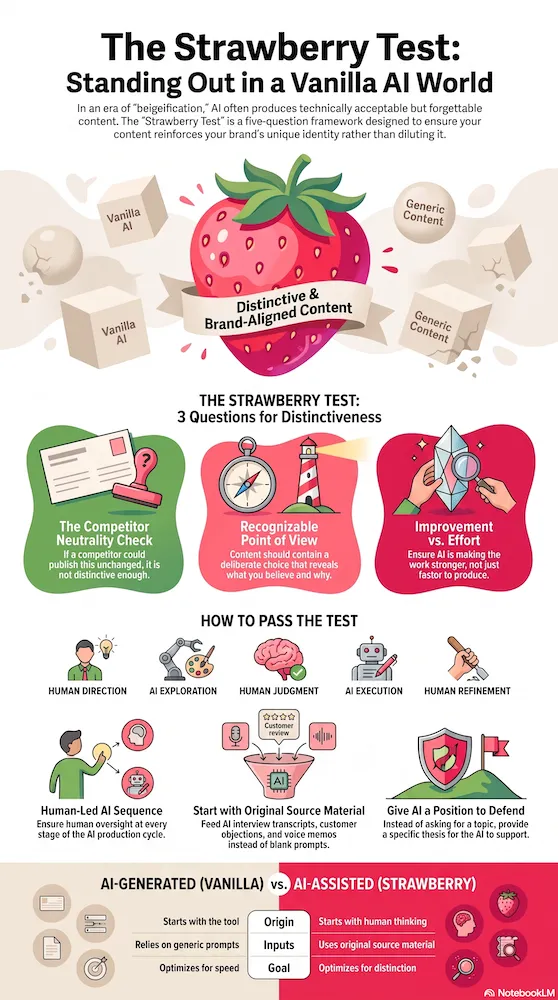
The Human-Led AI Content Sequence
The most effective AI content workflow is not “generate, proofread, publish.”
It is a human-led sequence in which AI supports the craft without replacing the person responsible for it:
1. Human direction
The process starts with a real objective, audience, point of view, source material, and quality standard. The human decides what the work should achieve and what it should communicate about the brand.
2. AI exploration
AI helps explore possible angles, structures, objections, interpretations, formats, or creative routes. At this stage, the tool expands the thinking rather than finalizing it.
3. Human judgment
The human evaluates what is true, relevant, distinctive, credible, and aligned with the brand. Weak directions are rejected, promising ideas are developed, and trade-offs are made deliberately.
4. AI execution
AI supports drafting, restructuring, visualization, formatting, production, or repurposing once the strategic direction is clear.
5. Human refinement
The final output is edited for accuracy, nuance, rhythm, brand coherence, evidence, and quality. The human remains accountable for what is published.
The sequence is:
Human direction → AI exploration → human judgment → AI execution → human refinement.
The problem is not using AI in the creative process. The problem is removing human direction and judgment from it.
The Strawberry Test: how to avoid generic AI-generated content
The Strawberry Test is a five-question framework for evaluating whether AI-assisted content strengthens a brand’s distinctiveness or merely adds to the volume of generic content.
Before publishing, ask:
1. Could a competitor publish this unchanged?
If the answer is yes, the work is not distinctive enough. Add your experience, evidence, language, interpretation, or position.
2. Is there a recognizable point of view?
Useful content does not always need to be controversial, but it should contain a deliberate choice. The reader should understand what you believe and why.
3. Does the work contain proof of craft?
Look for specificity, judgment, detail, coherence, and care. These signals show that someone considered the outcome rather than accepting the first usable draft.
4. Does it reinforce the brand you want to build?
A playful brand should not suddenly sound institutional. A premium advisory firm should not publish shallow listicles merely because they are easy to generate. Consistency is not repetition; it is coherence.
5. Is AI improving the outcome or merely reducing the effort?
Saving time is legitimate, but efficiency cannot be the only measure. The final work should be stronger because AI was involved, not simply faster to produce.
If your content fails the Strawberry Test, it probably needs more of you in it.
How to make AI-generated content more distinctive
Avoiding generic AI content does not require rejecting the technology. It requires improving what happens before, during, and after generation.
Start with source material, not a blank prompt
Feed the tool interview transcripts, customer objections, case-study notes, founder voice memos, research, examples, delivery lessons, and existing brand materials. Give it evidence of how your business actually thinks.
Give the AI a position to defend
Instead of asking for an article “about AI and branding,” state your thesis clearly:
AI is not damaging brands by itself. Businesses are damaging their brands by using AI to standardize what should make them recognizable.
A strong position gives the work direction.
Define creative constraints
Explain what the brand should and should not sound like. Provide examples of language, visual choices, formats, metaphors, and conventions to avoid. Constraints often create more distinctive work than open-ended instructions.
Ask for alternatives, not final answers
Use AI to generate several possible angles, structures, counterarguments, or creative routes. Treat the output as material for judgment rather than the finished product.
Add proof after the first draft
Review every claim and ask whether it can be supported by client experience, data, research, customer language, or a concrete example. Generic statements become credible when they are connected to evidence.
Edit for recognition, not only correctness
Do not limit editing to grammar and spelling. Ask whether the content could be recognized as yours, whether it reinforces your B2B positioning and brand differentiation, and whether it contains language another company would be unlikely to use.
Good enough is becoming expensive
For a while, good-enough AI content may appear efficient.
You save money on creative work. You publish more often. Your team fills the content calendar. The website launches faster. The pitch deck is completed before the meeting.
But brand damage rarely arrives as one dramatic event. It accumulates through small acts of indifference.
A generic landing page here.
A forgettable carousel there.
A pitch deck that resembles everyone else’s.
An article that says nothing objectionable and nothing memorable.
Eventually, the market sees a company that appears competent but interchangeable.
That is a dangerous position for any business whose growth depends on expertise, trust, referrals, reputation, capital, or premium pricing.
The purpose of AI should not be to help you reach the minimum acceptable standard more efficiently.
It should help you raise the standard.
In a vanilla world, be strawberry
The opportunity created by widespread AI adoption is not simply that everyone can produce more. It is that true distinctiveness is becoming rarer, which makes it more valuable.
When everyone has access to the same tools, the differentiator becomes what you bring to them.
Your taste.
Your experience.
Your judgment.
Your story.
Your evidence.
Your standards.
Your willingness to make choices that are specific enough not to appeal to everyone.
The brands that stand out in the AI era will not necessarily be the brands that reject technology. They will be the ones that refuse to let technology erase their identity.
Use AI to extend your thinking, not replace it.
Use it to improve the craft, not imitate the category.
Use it to become more recognizably yourself, not more efficiently like everyone else.
Because in a vanilla world, being strawberry is not an aesthetic indulgence.
It is a competitive advantage.
If your content, website, pitch deck, or visual identity makes your business look interchangeable with everyone else in your category, this is the work we do at nova*. We help founders and premium B2B firms turn their expertise, personality, and proof into a brand that is easier to recognize, trust, and choose.
Talk to nova* about your marketing strategy
FAQ on How to Avoid Generic AI-Generated Content
Why does AI-generated content often sound the same?
AI-generated content often sounds similar because businesses provide generic instructions without original experience, evidence, customer language, or a clear point of view. When the input lacks distinctive material, the system relies on familiar structures and broadly applicable language.
What is the difference between AI-generated and AI-assisted content?
AI-generated content is substantially created by an AI system from a prompt or instruction. AI-assisted content begins with human thinking, source material, evidence, and creative direction, while AI supports selected tasks such as drafting, editing, exploration, or repurposing.
Does AI-generated content damage a brand?
AI-generated content can weaken a brand when it is generic, inaccurate, inconsistent, or below the standard buyers expect. The risk does not come from using AI itself, but from publishing outputs without enough strategic direction, creative judgment, evidence, or human refinement.
How can businesses avoid generic AI-generated content?
Businesses should start with original source material, define a clear point of view, provide real examples, introduce creative constraints, and retain human judgment throughout the process. The Strawberry Test can also be used to assess whether the final work is distinctive, recognizable, crafted, brand-aligned, and genuinely improved by AI.
Can Google rank AI-generated content?
Google evaluates the usefulness, quality, originality, and reliability of content rather than rewarding or penalizing content simply because AI was used. AI-generated material is more likely to perform when it answers the search intent, demonstrates real expertise, adds original value, and is reviewed carefully for accuracy and quality.
Should businesses stop using AI for content creation?
No. AI can improve research, ideation, analysis, drafting, production, and repurposing. Businesses should retain human responsibility for positioning, evidence, point of view, brand identity, accuracy, creative direction, and final quality.
Why is brand differentiation more important in the AI era?
As more businesses gain access to the same tools, templates, and production capabilities, technical quality becomes easier to imitate. Distinctive thinking, recognizable brand assets, original evidence, and a coherent point of view therefore become more important sources of recognition and buyer preference.