



Ahlem Mahroua is the founder of nova*, a Marketing Advisory Studio helping founders and premium B2B firms become easier to find, trust, and choose. She has 20+ years of operator experience and has advised 400+ founders and enterprise boards across the GCC and Europe, including through Hub71, Sheraa, Plug and Play, and Techstars.
Connect with Ahlem Mahroua on LinkedIn.
Table of Contents for AI Tools for Content Creation
Most founders ask the same question when they start taking content seriously: “Which AI tools for content creation should I use?”
Should they use ChatGPT or Claude? Jasper or Copy.ai? Canva or Gamma?
Should they build their own content system because surely, somehow, they can create a better social media scheduler than Buffer between two client calls and a fundraising update?
The honest answer is usually less exciting: You are asking the wrong question.
The founders getting the best results from AI are not necessarily the ones using the most advanced tools. They are the ones who know what they want the content to do before they ask AI to create it.
- They know who they are speaking to.
- They know what their buyer cares about.
- They know what they want to be known for.
- They know what proof makes them credible.
- They know what action the content should create.
That is why their content works. Not because they found a magical prompt. Not because they installed eighteen tools. Not because they outsourced their entire brain to AI and hoped for thought leadership to appear.
AI can only multiply what you give it.
- If your positioning is vague, AI will give you more vague content.
- If your proof is scattered, AI will not know what makes you trustworthy.
- If you do not understand your buyer, AI will not magically find the right angle.
And if you ask AI to “write a LinkedIn post about our company,” do not be surprised when it gives you something polished, empty, and painfully similar to everyone else.
The issue is not the tool. The issue is the system underneath the tool.
This guide is for B2B founders, CEOs, consultants, agencies, professional services firms, and high-ticket businesses that want to use AI tools for content creation without sounding generic.
More importantly, it is for founders who understand that content is no longer just marketing.
- Content is how you get found.
- Content is how you build trust before the sales call.
- Content is how a prospect decides whether you are the obvious choice or just another option.
The real content problem most founders have
Most founders have a clarity problem rather than a content problem.
The LinkedIn post does not get written because the founder is busy, yes. But also because every time they sit down to write, they are not sure what to say.
The website does not convert because the copy is weak, yes. But also because the positioning underneath it is too broad.
The sales deck feels outdated because nobody has had time to update it, yes. But also because the company’s strongest proof is sitting in client calls, proposals, emails, WhatsApp messages, investor updates, screenshots, case studies nobody wrote, and founder stories nobody collected.
Then the founder opens ChatGPT and asks for content.
AI looks at the input and does what AI does best. It produces more of the same.
- More unclear messaging.
- More generic posts.
- More “we are excited to announce.”
- More “in today’s fast-paced digital landscape.”
- More content that sounds like content.
That is why so many founders feel disappointed by AI tools for content creation. Not because the tools are bad. Many of them are genuinely useful. But because they are being used to solve the wrong layer of the problem.
AI is good at accelerating execution. It is not good at deciding what your company should stand for. That work still belongs to you.
Start with the output, not the tool
Before choosing your AI content stack, define the output you actually need.
A founder trying to become more visible does not need the same system as a law firm trying to look more credible online.
A B2B SaaS founder trying to educate buyers does not need the same system as a consultant trying to convert referrals into calls.
A family office building authority in a specific industry does not need the same system as an early-stage founder trying to clarify their website for B2B sales.
The tool should follow the commercial objective.
Before you touch ChatGPT, Claude, Jasper, Canva, Gamma, or any other AI content creation tool, answer these five questions:
- Who are we trying to influence?
- What do we want them to believe about us?
- What proof do we have?
- Where do they currently discover and evaluate us?
- What action should the content create?
These questions sound basic. They are not. They are the difference between AI slop and useful content.
Because once you answer them properly, AI becomes much more powerful. It stops being a random writing machine and becomes an execution layer for a real marketing system.
The founder content system: found, trusted, chosen
For most B2B founders and high-ticket firms, content has three jobs.
- It should help you become found.
- It should help you become trusted.
- It should help you become chosen.
If your content only gets you found, but does not build trust, people will read and leave.
If your content builds trust, but does not create preference, you become “interesting” but not commercially relevant.
If your content tries to make people choose you before they understand or trust you, it feels like a pitch.
A good AI-assisted content system should support all three layers.
1. Found
This is the visibility layer.
It includes SEO articles, LinkedIn posts, social search, founder-led content, company pages, newsletters, and any format that helps the right people discover you.
For this layer, AI tools can help you:
- turn customer questions into article ideas
- create SEO outlines
- repurpose long-form content into short posts
- identify recurring themes from sales calls
- build a publishing calendar
- create first drafts faster
But AI cannot tell you which topics matter commercially unless you give it context.
A topic is not valuable because it has search volume. A topic is valuable when it sits at the intersection of what your buyer is searching for, what your company can credibly talk about, and what your offer helps solve.
That is why founders should not ask: “What content should I post this week?”
They should ask: “What does my buyer need to understand before they trust me enough to buy?”
That is a much better starting point.
2. Trusted
This is the credibility layer. Trust is built through specificity.
- Specific examples.
- Specific proof.
- Specific opinions.
- Specific experience.
- Specific customer problems.
This is where many AI-generated posts fail. They sound clean, but they have no evidence.
They say: “We help companies grow with better marketing.” That could mean anything.
A stronger version says: “We helped two early-stage founders clarify their positioning, rebuild their B2B sales websites, and double their lead volume within 30 days of publishing the new site.”
That is the difference: the first sentence is a claim, the second sentence is proof.
AI can help you package proof, but it cannot invent proof worth trusting.
This is why every founder needs a proof bank before they need a content calendar.
A proof bank is a simple document where you collect:
- customer wins
- before-and-after examples
- founder insights
- objections from sales calls
- client questions
- screenshots
- testimonials
- workshop outcomes
- case study notes
- industry observations
- lessons learned from delivery
Once this exists, your AI tools for content creation become much more useful.
Instead of asking AI to create generic thought leadership, you can ask it to turn real proof into useful content.
3. Chosen
This is the preference layer. Being chosen means your buyer does not just understand what you do. They prefer you over the alternatives.
That is where positioning matters. Your content should make people think:
- “This person understands my problem.”
- “They have seen this before.”
- “They have a clear point of view.”
- “They are not just repeating what everyone else says.”
- “They would probably be useful to work with.”
That is very different from simply publishing more.
A founder can post every day and still not become the obvious choice; a company can publish SEO articles every week and still sound interchangeable; a marketing team can use every AI tool available and still produce content that does not move the buyer.
The objective is not volume. The objective is preference.
The AI content stack I recommend for founders
There is no perfect AI content stack. There is only the stack that fits your objective, your team, your budget, and your ability to maintain it.
For most B2B founders and high-ticket service businesses, I would keep the stack simple.
ChatGPT: best for speed, ideation, and repurposing
ChatGPT is useful when you need options quickly.
Use it for:
- brainstorming angles
- generating article outlines
- turning one idea into several content formats
- creating variations of LinkedIn posts
- drafting email sequences
- summarising call notes
- creating prompt templates
- building content calendars
Where ChatGPT works especially well is repurposing.
For example, you can give it a transcript from a founder voice note and ask it to extract:
- one LinkedIn post
- one newsletter idea
- three hooks
- one sales email angle
- five objections worth addressing in future content
That is useful. What you should not do is ask it to create your point of view from scratch. ChatGPT can help structure thinking. It should not replace thinking.
Claude: best for long-form writing and refinement
Claude is especially useful for longer pieces that need nuance.
Use it for:
- article drafts
- founder essays
- website copy
- positioning narratives
- sales deck storylines
- proposal copy
- tone refinement
- synthesis from long documents
Claude is also useful when you want writing to sound less mechanical. For content that needs to feel thoughtful, not just efficient, Claude is often strong at coherence, structure, and flow.
A good workflow is to use ChatGPT for angle generation and Claude for long-form drafting or refinement.
For example:
- Use ChatGPT to generate ten angles from a client call.
- Choose the strongest one yourself.
- Use Claude to build the article structure.
- Edit manually to add your opinion, proof, and examples.
This is what I mean by AI-augmented, not AI-written.
Jasper: best for brand consistency at scale
Jasper becomes useful when you are no longer just creating one piece of content. You are trying to maintain consistency across campaigns, teams, and formats.
For a founder-led company, Jasper can help when you have:
- defined brand voice
- clear messaging guidelines
- recurring content formats
- multiple people producing content
- a need for consistency across channels
It is less useful if your strategy is still unclear. Do not buy a brand voice tool before you know what your brand voice is. That sounds obvious, but many companies do exactly that.
They try to operationalise a voice they have not defined.
Copy.ai: best for repeatable GTM workflows
Copy.ai is useful when content creation is part of a broader go-to-market workflow.
For example:
- sales emails
- outbound sequences
- account research
- CRM-related content tasks
- repeatable campaign workflows
- messaging variations for different segments
This is where Copy.ai is stronger than a simple blank-page AI writer. It is designed around repeatable workflows, which matters when you want process, not just one-off drafts.
For a B2B founder, this can be useful when you have a clear sales motion and need to create consistent messaging across multiple buyer segments. Again, the tool works best when your inputs are clear.
Bad positioning plus automation simply creates bad positioning at scale.
Canva: best for social visuals and simple branded assets
Canva is useful for founders because it removes the design bottleneck.
You can use it for:
- LinkedIn carousels
- simple diagrams
- event posts
- quote cards
- workshop assets
- proposal visuals
- presentation design
- branded templates
The danger with Canva is that everything can start to look like a template. But here the bottleneck is the lack of branding rather than the tool itself.
The best use of Canva is not to make more visuals. It is to create a small library of repeatable branded formats that make your content easier to recognise.
For example:
- one carousel template for teaching
- one proof post template
- one quote or insight template
- one event recap template
- one case study snapshot template
You do not need thirty templates. You need five that your team will actually use.
Gamma: best for fast decks, proposals, and narrative assets
Gamma is useful when you need to turn structured thinking into a clean presentation quickly.
Use it for:
- sales decks
- workshop decks
- proposal narratives
- founder presentations
- internal strategy documents
- simple landing page concepts
But remember: a deck is not a design problem first. It is a narrative problem.
Before opening Gamma, define the story:
- What problem does the buyer have?
- Why does it matter now?
- What is your point of view?
- What solution are you proposing?
- What proof supports it?
- What should the buyer do next?
Once that is clear, Gamma can help you turn the structure into something presentable.
Without that structure, you get a nice-looking deck that does not persuade anyone.
A simple AI content workflow founders can actually maintain
The best content system is not the most sophisticated one, it is the one you will use consistently.
For many founders, I recommend a weekly input system.
Not daily posting or endless brainstorming, not building a complicated automation system nobody maintains, rather just one weekly input session.
Here is how it works.
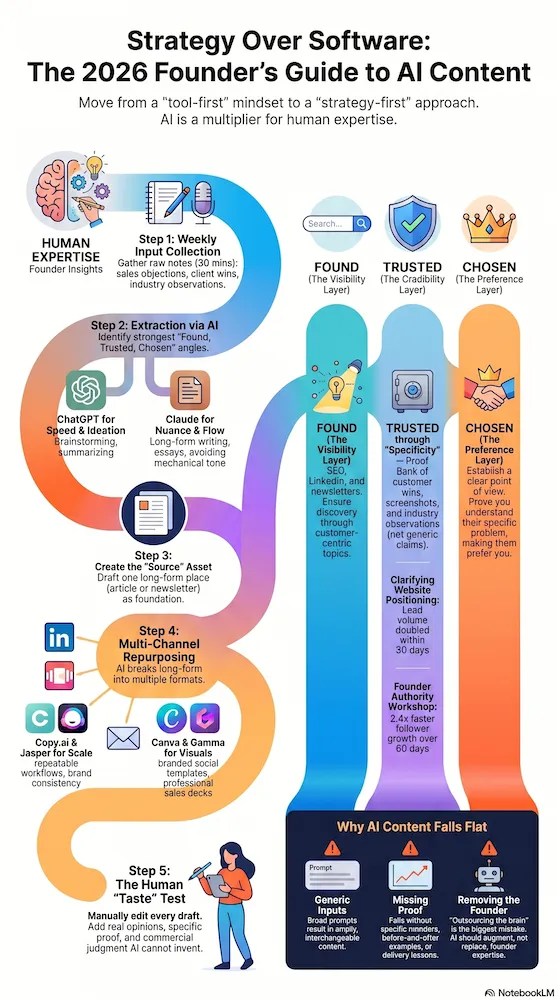
Step 1: Collect raw input once a week
Set aside 30 minutes.
Collect:
- customer questions from the week
- sales objections
- industry observations
- events attended
- lessons from delivery
- closed deals or wins
- internal insights
- founder opinions
- recurring conversations
- useful screenshots or data points
This can be done in a Google Doc, Notion page, or simple running document. Do not over-engineer it.
The goal is to capture the thinking before it disappears.
Step 2: Turn inputs into content angles
Give the input to ChatGPT or Claude and ask:
“From the notes below, extract the strongest content angles for a B2B founder audience. Prioritise angles that help us become found, trusted, and chosen. For each angle, explain the buyer problem it addresses, the proof we can use, and the best format.”
This is where AI is very useful.
- It can see patterns across messy inputs.
- It can turn raw notes into usable angles.
- It can help you identify which ideas are better suited for LinkedIn, SEO, newsletters, or sales materials.
Step 3: Create one long-form asset
Choose one strong idea and create a longer piece.
This could be:
- a blog article
- a newsletter
- a founder essay
- a case study
- a point-of-view memo
The long-form asset becomes the source.
This is important. Most founders try to create short-form content from nothing. That is why it feels hard. It is easier to create short content from a strong long-form idea.
Step 4: Repurpose into short-form content
From the long-form asset, create:
- two LinkedIn posts
- three short observations
- one carousel idea
- one sales email angle
- one website or sales deck update
This is how content becomes a system. One idea feeds multiple channels. The founder does the thinking once and AI helps with packaging.
Step 5: Edit manually before publishing
This is the step most people want to skip. Do not skip it!
Before publishing, ask:
- Does this sound like us?
- Is there a real opinion?
- Is there proof?
- Is it useful without being generic?
- Would our buyer care?
- Does it create the right action?
AI can produce the draft but you still need to add taste, judgment, and commercial context.
That is the part people trust.
Example: the family office content flywheel
A simple example.
For a family office, we built a content flywheel around one weekly input session.
The team collected:
- events they attended
- industry insights
- investment themes
- closed deals
- internal observations
- questions from their network
From that weekly input, the system produced:
- one blog article
- two LinkedIn posts for the company page
- a stronger archive of market observations over time
This worked because the system did not start with:
“What should we post?”
It started with:
“What did we learn this week that our market should associate with us?”
That question is much more powerful. It turns content into authority building.
Example: positioning before website content
In another case, two early-stage founders needed help clarifying their positioning before rebuilding their websites for B2B sales.
The issue was that their product was great but the messaging and the website looked “amateurish” and as a result the value was not clear enough for the buyer at first glance.
We clarified:
- who the offer was really for
- what problem the buyer recognised
- why the timing mattered
- what proof made the offer credible
- what action the website should create
Then the website was rebuilt around that logic.
Within 30 days of publishing the new sites, their lead volume doubled. That did not happen because of AI. It happened because the strategy became clearer.
AI can help speed up website copy, landing page variations, SEO drafts, and content repurposing. But the reason the content converts is the positioning underneath it.
Example: founder authority after a workshop
I ran an authority-building workshop with founders in a top UAE accelerator.
The message was simple: Do not post for visibility only, rather post to become easier to trust.
The founders who implemented the advice grew 2.4x faster in follower growth over the next 60 days compared with those who did not.
Follower growth is not the whole business, obviously. But it is a signal.
When founders became clearer about their audience, their point of view, and their proof, their content started to travel better. That is the pattern I keep seeing.
The best AI tools for content creation are not replacing founder expertise. They are helping package it more consistently.
Prompts that make AI content better
Prompts are not magic. But better prompts force better thinking.
Here are a few useful ones.
Prompt 1: Build a content strategy before creating content
“Act as a B2B content strategist. Based on the information below, help me define a content strategy that makes us easier to find, trust, and choose. Identify our primary buyer, what they care about, what we should be known for, what proof we need to show, and what content formats would best support the buying journey.”
Prompt 2: Turn raw founder thinking into content angles
“Below are rough notes from my week. Extract the strongest content ideas. For each idea, give me the buyer problem, the core insight, the proof I should include, and the best format: LinkedIn post, SEO article, newsletter, sales email, or deck slide.”
Prompt 3: Create a proof-based LinkedIn post
“Turn this proof point into a LinkedIn post for a B2B founder audience. Do not make it sound like a case study. Make it useful to the reader. Start with the lesson, explain the mistake most founders make, then show the example as proof.”
Prompt 4: Improve an AI draft so it sounds less generic
“Review this draft and identify every sentence that sounds generic, inflated, or like AI-written marketing copy. For each one, suggest a sharper version using specific language, founder experience, and proof. Do not make the tone overly polished.”
Prompt 5: Turn one article into a content system
“Take the article below and repurpose it into: three LinkedIn posts, one newsletter intro, five short social posts, one sales email angle, and three ideas for future SEO articles. Keep the same point of view across all formats.”
The point is not to prompt your way into expertise. The point is to use AI to process expertise you already have.
When AI content falls flat
AI content usually falls flat for five reasons.
1. The input is too generic
If you give AI generic instructions, you get generic content.
- “Write a post about leadership.”
- “Write an article about AI tools.”
- “Create content for our consulting business.”
These prompts are too broad.
Useful content needs context.
- Who is the buyer?
- What do they already believe?
- What are they getting wrong?
- What do you know that they do not?
- What proof do you have?
Without that, the output will sound fine and say very little.
2. There is no point of view
A lot of AI-generated content is structurally correct but strategically empty.
It has a hook, bullet points, intro, conclusion, etc…
But it does not take a position. Good content needs tension. It should challenge something. For example in that article, I could have said “AI tools help founders create content faster”, and yes that’s an ok point of view. But you’d have asked, so what?
“Most founders should stop asking which AI tool to use and start asking what they want their buyer to believe” is a stronger point of view, because it challenges the idea that AI alone will help you create better content.
It’s never AI alone though, it’s always your brain + AI.
3. The proof is missing
Your buyer does not trust you because you published. They trust you because the content shows evidence.
- Use examples.
- Use numbers.
- Use before-and-after moments.
- Use patterns from client work.
- Use lessons from delivery.
- Use what you are seeing in the market.
AI can make content sound more professional, but proof is what makes it credible.
4. The workflow is too complicated
Some founders create a content system so complex it becomes impossible to maintain.
They build databases, automations, tagging systems, templates, approval flows, and dashboards before they have published ten useful posts.
But I really believe this is backwards. My view: start simple.
- Capture input once a week.
- Create one strong idea.
- Repurpose it.
- Publish.
- Repeat.
You can always add complexity later.
5. The founder removes themselves from the process
This is the biggest mistake. Founders want AI to save time, which is fair. But some go too far, and they remove their thinking, their stories, their opinions, their judgment, and their taste.
Then they wonder why the content does not sound like them.
Your content should not be AI-written. It should be AI-augmented, and there is a massive difference.
AI-written content starts with the tool. AI-augmented content starts with your thinking and uses the tool to shape, structure, and distribute it.
Should founders build their own content tools?
Sometimes. But usually, no.
If content infrastructure is core to your product, if you have a technical team, if you need specific data control, or if your workflow is genuinely unique, building your own system can make sense.
But most founders do not need to build a better scheduler, they actually need to write something worth scheduling first.
And actually, to deliver impact for their audiences, they do not need a custom AI content machine.
They need a clearer positioning system, a proof bank, and a workflow they can actually maintain.
The danger with building your own tool too early is that it can become a very sophisticated way to avoid the harder question: “What do we actually want to say?”
Start there. Then choose the tools.
The best AI tools for content creation are only multipliers
Here is the simplest way to think about it.
- ChatGPT helps you move faster.
- Claude helps you write and refine better long-form content.
- Jasper helps maintain brand consistency when the strategy is already defined.
- Copy.ai helps create repeatable GTM and content workflows.
- Canva helps turn ideas into branded visuals.
- Gamma helps turn structured thinking into decks and presentations.
All useful but remember that none of them replace strategy.
The partners getting the most from AI are not using it to avoid thinking. They are using it to make their thinking travel further.
That is the real opportunity, not more content but sharper content.
- Content that helps the right people find you.
- Content that makes them trust you before the first conversation.
- Content that makes choosing you feel obvious.
Before you add another AI tool to your stack
Before you integrate another AI tool for content creation, pause and answer this:
What do you want your content to make people feel, believe, and do?
- Feel understood?
- Believe you are credible?
- Trust that you have solved this before?
- Choose you over another provider?
- Book a call?
- Refer you?
- Remember you?
That clarity matters more than the software.
Of course AI can help you publish faster, repurpose better, organise ideas, draft articles, build decks, create visuals, and maintain consistency.
But it cannot decide what your business should be known for, that job is yours. And only when that part is clear, the tools finally become useful.
If you are a founder or CEO building a high-ticket B2B business and you want your marketing to make you easier to find, trust, and choose, this is the work we do at nova*.
Let’s talk today
We help founders clarify their positioning, build authority, and create content systems that turn expertise into trust.
Before you add another AI tool to your stack, get clear on the marketing system it is supposed to support. Then use AI to multiply that.
FAQ on AI Tools For Content Creation
1. What are the best AI tools for content creation in 2026?
The best AI tools for content creation depend on your goal. ChatGPT is widely used for brainstorming and drafting, Claude excels at long-form writing and refinement, Copy.ai supports repeatable sales and marketing workflows, Canva AI helps create branded visual content, and Gamma simplifies pitch deck and presentation creation.
2. Can AI tools create LinkedIn content for founders?
Yes. AI tools can help founders turn a single idea into multiple LinkedIn post formats, including thought leadership posts, founder stories, question-led posts, and educational content. However, the strongest-performing posts still require personal insights, real experiences, and a clear point of view from the founder.
3. Are AI-generated emails effective for B2B outreach?
AI-generated emails can be highly effective when they are personalised and based on real prospect context. The most successful founders use AI to improve specificity, relevance, and message quality rather than simply increasing email volume.
4. What is the difference between ChatGPT and Claude for content creation?
It depends on whether you’re selling inventory or services. For product-based businesses with ChatGPT is generally preferred for speed, brainstorming, and generating multiple content variations quickly. Claude is often preferred for long-form content, natural writing style, and maintaining coherence across longer documents. Many founders use both tools together as part of their content workflow.
5. Can AI tools help create sales decks and presentations?
Yes. AI tools such as Claude and ChatGPT can help structure the narrative and write slide content, while Gamma and Canva AI can automatically transform that content into professional presentations. This significantly reduces the time required to create proposals, pitch decks, and sales presentations.
6. What are the limitations of AI content creation tools?
AI tools can generate content quickly, but they cannot replace positioning, market understanding, or strategic thinking. If the messaging, target audience, or value proposition is unclear, AI will simply produce more content that fails to convert.
7. How can founders use AI to create content consistently?
Founders can use AI to repurpose a single insight into multiple content formats, including LinkedIn posts, outreach emails, newsletters, and presentation content. This allows them to maintain a consistent publishing schedule without spending hours creating content from scratch.
8. Do AI content creation tools improve SEO performance?
AI tools can help accelerate content production, keyword research, content structuring, and content optimisation. However, SEO success still depends on search intent alignment, expertise, originality, topical authority, and a clear content strategy.
9. Which AI content creation tool is best for small businesses?
For most small businesses, ChatGPT offers the best balance of affordability and flexibility. Businesses that need brand consistency may prefer Jasper, while those focused on sales outreach often benefit from Copy.ai. The best choice depends on the content workflow and business objectives.
10. Are AI tools replacing content writers and marketers?
No. AI tools are changing how content is produced, but they are not replacing strategic marketers, copywriters, or content leaders. The most effective use of AI is as a productivity multiplier that speeds up execution while humans provide positioning, expertise, creativity, and commercial judgment.