



Ahlem Mahroua is the founder of nova*, a Marketing Advisory Studio helping founders and premium B2B firms become easier to find, trust, and choose. She has 20+ years of operator experience and has advised 400+ founders and enterprise boards across the GCC and Europe, including through Hub71, Sheraa, Plug and Play, and Techstars.
Connect with Ahlem Mahroua on LinkedIn.
Table of Contents – B2B SaaS Business Ideas 2026
Most founders don’t fail because they lacked ideas, in our experience, they fail because they picked ideas that were never commercially viable to begin with.
If you’re searching for B2B SaaS business ideas for founders, the filter matters more than the idea list.
The B2B SaaS market in 2026 is full of noise: AI wrappers with no differentiation, over-engineered platforms solving problems nobody pays to fix, copy-paste tools in saturated categories with better-funded competitors already entrenched.
Studios like nova* spend most of their time working with founders who’ve already picked an idea but have no structured path to revenue. That’s a problem that starts much earlier, at the idea stage itself.
This article takes a framework-first, ideas-second approach.
Use the filter before you fall in love with any concept.
Then shortlist two or three ideas that match your skills, your risk tolerance, and your ability to reach a first paying customer.
What separates a commercially viable SaaS idea from wishful thinking
Most SaaS ideas die not from a bad product but from bad market selection. The idea sounds compelling in a coffee shop conversation and falls apart the moment you look at who’s actually paying for anything adjacent to it.
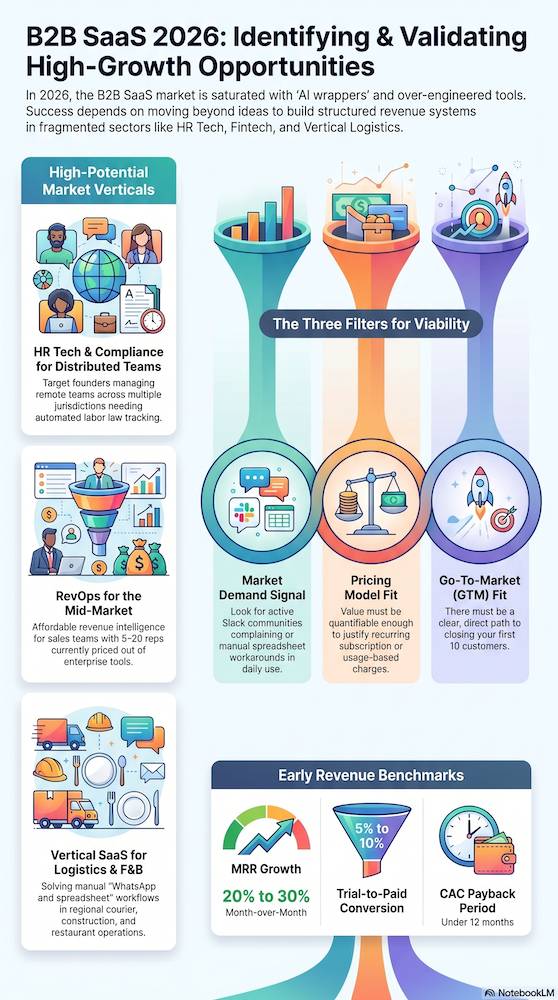
Every strong B2B SaaS business idea for founders passes three filters:
- market demand (someone is actively paying to solve this problem right now),
- pricing model fit (the value is quantifiable enough to charge for consistently),
- and GTM fit (there’s a clear, direct path to a first paying customer).
Skip any one of these and you’re building on sand.
What real market demand looks like before you build
Demand isn’t people saying “that sounds useful.” Real signals look like active Slack communities complaining loudly about the same problem, spreadsheet workarounds in daily use across an industry, money already being spent on adjacent and inferior tools, and job postings describing the exact role your product would replace or support.
If none of those signals exist, the problem likely isn’t painful enough for anyone to pay a meaningful monthly subscription to solve, think SMB-range pricing upward of $300 a month.
Why pricing model fit is a product decision, not a sales decision
The four main B2B SaaS pricing models are subscription tiers, usage-based, seat-based, and enterprise contracts.
The nature of the problem determines which model fits, not your preference. A compliance tool that saves an HR team 15 hours a month has a different pricing reality than an API called 10,000 times a day.
Get this wrong early and your pricing will always feel like a negotiation rather than a given.
GTM fit: who closes the first 10 customers and how
The right idea for a solo founder looks completely different from the right idea for a well-funded team. Founder-led sales works best when the buyer is someone you can reach directly, the sales cycle is short, and the value proposition lands without a six-month proof-of-concept.
If your idea requires a large enterprise contract to be economically viable, that’s not a solo-founder play.
High-potential HR tech and workforce SaaS ideas for 2026
HR tech is massively fragmented at the SMB layer. Large platforms dominate enterprise; the mid-market is still patching together point solutions.
That gap comes with identifiable buyers and a demonstrated willingness to pay, especially for tools that remove compliance risk or cut manual admin time.
Compliance and labor law tracking for distributed teams.
The distributed workforce explosion created a cross-jurisdiction compliance problem that no dominant SMB-focused tool addresses cleanly. Subscription pricing at $99 to $499 a month fits well here.
Your earliest customers are founders or HR managers running remote teams across three or more countries, people who are either ignoring the problem entirely or paying employment lawyers far too much to manage it manually.
Onboarding automation for high-turnover SMB industries.
Restaurants, construction firms, and retail operators face notoriously high annual staff turnover, often cited in industry surveys above 70 percent in sectors like hospitality, and most still run onboarding on paper or email.
No niche SaaS dominates this space. Seat-based pricing at $8 to $15 per employee per month is a natural structural fit.
The easiest first call is a multi-location operator who can’t justify an enterprise HRIS contract but is drowning in manual rehire cycles.
AI-assisted performance tooling for non-desk workers.
Most existing performance management tools were designed around office-based workflows, leaving field teams, hourly workers, and trade workers largely underserved.
Usage-based or per-location pricing keeps entry simple.
Target accounts are regional contractors or franchise operators with no structured way to measure field performance, not because they don’t want it, but because nothing affordable exists for them yet.
Real signals look like active Slack communities complaining loudly about the same problem, spreadsheet workarounds in daily use across an industry, money already being spent on adjacent and inferior tools, and job postings describing the exact role your product would replace or support.
Ahlem Mahroua, founder nova* growth studio
Fintech and RevOps SaaS ideas with real pricing power
Fintech and RevOps sit closest to money. When your tool saves or generates revenue directly, pricing resistance drops.
The RevOps market is tracking toward $5 billion or more by 2026, growing at roughly 16 to 17 percent annually per market analyst estimates (RevOps trends for 2026), and the SMB and mid-market layer is still wide open.
Revenue intelligence for mid-market B2B sales teams.
Enterprise revenue intelligence tools are priced for large organizations, often $100,000 or more per year when fully deployed.
Mid-market sales teams with 5 to 20 reps have no clean, affordable alternative.
Pricing at $50 to $150 per seat per month is illustrative of where this segment shows willingness to pay. Start with sales-led SaaS companies or agencies with growing outbound teams currently flying blind on pipeline data.
Accounts payable automation for regional SMEs.
Most SMEs in high-growth markets like the GCC, Southeast Asia, and Latin America still reconcile accounts payable manually.
Global platforms exist but lack local compliance hooks.
A subscription plus usage model based on invoice volume fits well. A good early-stage target is a professional services firm or trading company processing a high volume of invoices each month, typically 100 or more, with no automation layer in place.
Financial close and reporting tools for founder-led businesses.
Founders who’ve outgrown spreadsheets but can’t justify a full-time CFO are stuck.
Month-end close takes 5 to 10 days of manual work by someone who shouldn’t be doing it.
The sub-$500 per month segment for founder-friendly financial close tooling is thin, most options are either enterprise-grade or too generic to be useful. Flat subscription pricing at $199 to $499 a month with a tight scope makes this immediately accessible.
If you need a practical starting point for planning pricing and build costs, see this guide on how to calculate a SaaS budget.
B2B SaaS business ideas for founders: logistics, operations, and vertical plays worth your attention
Vertical SaaS in logistics and operations is underbuilt and often benefits from higher retention than horizontal tools, because workflow integration makes switching genuinely painful. A logistics coordinator who builds her operation around your tool doesn’t leave. These are solid small-team or solo-founder plays with identifiable buyers and documented operational pain.
Last-mile delivery tracking for regional 3PLs and courier companies.
Large platforms are overkill for regional operators. Small courier companies want basic track-and-notify functionality without a six-month implementation. Usage-based pricing per delivery event or a flat monthly fee works cleanly.
A practical first target is a regional courier company doing 500 to 5,000 deliveries per month with no current visibility tool, a range that reflects the lower threshold where manual tracking breaks down.
Procurement and vendor management for construction and F&B.
Construction groups and restaurant chains manage procurement on WhatsApp and spreadsheets. No niche SaaS dominates here. Per-location or seat-based pricing at $50 to $200 a month is a reasonable starting range. Start with multi-site F&B operators or regional contractors who are tired of chasing invoices across group chats.
Inventory reconciliation for multi-location retail operators.
Multi-location retail in the GCC and Southeast Asia runs on disconnected POS systems. Reconciliation is manual, error-prone, and time-consuming. Per-location SaaS pricing at $99 to $299 a month gives this idea a clear commercial structure. The buyer pain is real and budget already exists for a tool that solves it.
For founders building GTM plans into these regions, our go-to-market strategy for MENA covers the patterns that matter when you sell across GCC and nearby markets.
How to validate any of these ideas before writing a single line of code
The worst thing a founder can do is fall in love with an idea and build for six months before testing demand. Most validation frameworks are overcomplicated.
You need a small set of strong signals before you move, not a 90-day market research project.
The PMF signal that matters most before you have customers
Run a Sean Ellis survey with 30 to 40 recent users or waitlist signups. Ask how they’d feel if they could no longer use your product. A 40 percent “very disappointed” response is the threshold that matters.
You can run this with a simple landing page before you’ve written any code.
Organic signals count too: people asking to pay before the product is ready, inbound interest with no paid ads, direct referrals in the first two weeks. When those show up together, you’re looking at real demand.
For practical approaches to how to measure product-market fit, there are straightforward guides that map the Sean Ellis survey into early-stage tactics.
What MVP actually costs and how long it realistically takes
Micro-SaaS builds typically run $20,000 to $60,000 and take 8 to 16 weeks. Enterprise-grade SaaS runs $50,000 to $100,000 or more, with a 4 to 9 month timeline.
The gap isn’t just money, it’s complexity, compliance requirements, and integration depth.
Match your idea’s scope to your actual resources before committing to a build. See a realistic breakdown of micro-SaaS costs to avoid underestimating timelines and spend.
Early revenue metrics worth tracking from day one
- MRR growth of 20 to 30 percent month-over-month is healthy for early-stage B2B SaaS.
- Trial-to-paid conversion of 5 to 10 percent is your baseline.
- CAC payback period under 12 months is the floor for sustainable unit economics.
If any of these are wildly off, the pricing model or positioning is broken, and it’s usually before the product is.
The idea is not the hard part. The revenue system is.
Most founders who pick a genuinely good SaaS idea still stall.
Not because the product is bad. Because they have no structured revenue system around it. No GTM framework, no positioning clarity, no repeatable sales motion.
Why most good SaaS ideas die at the go-to-market stage
Founders build the product, launch it, and expect inbound to happen. It doesn’t.
The first 10 customers require a deliberate, structured outreach motion. Most founders have no framework for this, no positioning that differentiates their tool from obvious alternatives, and no repeatable process for converting early interest into signed contracts.
The product was never the problem.
What it looks like to go from concept to a structured revenue system
Building around an idea becomes architecture when you have a clear ICP, differentiated positioning, a structured outreach motion, pipeline tracking, and a conversion framework that repeats. nova* works specifically on this transition: taking founders who’ve landed on a commercially viable idea and building the revenue architecture that makes it scalable, rather than leaving them with a product and no system to sell it.
Pick the idea. Then build the system around it.
The 2026 B2B SaaS opportunity is real. Vertical SaaS is growing, HR tech is fragmented, RevOps is underpenetrated at the mid-market, and logistics tools are barely built.
But the opportunity means nothing without the filter: market demand, pricing model fit, and GTM fit.
These are the strongest B2B SaaS business ideas for founders in 2026, but a list only gets you so far.
Pick two or three SaaS startup ideas from this article that match your skills and risk profile. Run a fast validation play using the signals above. Resist the urge to build before you have proof that someone will pay for what you’re making.
The idea is not the hard part. The discipline to validate before you build, and the startup growth system to sell after you do, that’s where most founders lose the game. Start there.
Want to validate your idea before building it? Reach out for a 30-minutes strategy call
FAQ on B2B SaaS Business Ideas 2026
1. What makes a B2B SaaS idea commercially viable?
Strong SaaS ideas combine clear market demand, measurable business value, pricing model alignment, and a realistic path to acquiring the first paying customers.
2. How should founders validate a SaaS idea before building?
Validation should include customer interviews, demand signals, pricing testing, waitlist engagement, workflow observation, and evidence that buyers are already spending money on adjacent solutions.
3. What are the most promising B2B SaaS categories in 2026?
High-potential areas include RevOps, vertical SaaS, AI-assisted operational tooling, HR compliance systems, logistics software, and SMB financial operations.
4. Why do many SaaS startups fail after launch?
Many founders focus on product development before building positioning clarity, GTM strategy, ICP definition, and a repeatable commercial system.
5. What is founder-led GTM in SaaS?
Founder-led GTM is an early-stage growth approach where founders directly drive positioning, outreach, customer conversations, and initial sales before scaling into a broader commercial team.




Comment
The 20-30% MRR growth benchmark is useful, but for bootstrapped founders it often masks a painful reality: churn eats the top. Even modest 3-4% monthly churn drags net MRR growth below 15% quickly. We track both gross and net religiously with the approach we use.