


Ahlem Mahroua is the founder of nova*, a Marketing Advisory Studio helping founders and premium B2B firms become easier to find, trust, and choose. She has 20+ years of operator experience and has advised 400+ founders and enterprise boards across the GCC and Europe, including through Hub71, Sheraa, Plug and Play, and Techstars.
Connect with Ahlem Mahroua on LinkedIn.
Table of Contents for Founder-Led Marketing: Become a Media Company
For the past decade, marketers have argued that every company would eventually need to become a media company. Businesses could no longer rely entirely on advertising, public relations, or external publishers to reach their markets; they needed to create useful ideas, build direct audiences, and own more of their distribution.
I believe the next shift is already happening: individuals are becoming media companies too.
This is particularly true for founders, solopreneurs, consultants, investors, senior executives, and expert-led businesses. Their expertise may sit inside a company, but attention and trust increasingly attach to the people communicating that expertise.
That does not mean everyone needs to become an influencer, post every day, or turn their private life into content. It means people whose careers and businesses depend on expertise can no longer assume that being good at the work is enough for the market to recognize their value.
Hard skills still matter. They are the foundation. But expertise that remains trapped inside meetings, client work, private conversations, and someone’s head creates less market leverage than expertise that is clearly articulated, consistently distributed, and publicly associated with a credible person.
I spent six years at Google working with publishers and digital platforms, and the principle was always the same: producing value and distributing value are different capabilities. You can create excellent work, but without a route to an audience, the market may never discover it.
The future of building a business is therefore not simply building a company and then promoting it. It is building a media layer that powers the company:
Expertise creates ideas → ideas become media → media builds an audience → the audience creates trust → trust creates opportunities.
That is the founder-led marketing flywheel.
What is founder-led marketing?
Founder-led marketing is a strategy in which the founder becomes one of the primary voices through which a company communicates its expertise, point of view, story, and proof.
Rather than delegating all public communication to a corporate page, paid advertising, or a faceless marketing department, the founder participates directly in building market awareness and trust through articles, social posts, newsletters, interviews, videos, podcasts, events, and conversations.
The objective is not to make the founder famous. It is to make the company’s expertise easier to discover, understand, remember, and trust.
A founder-led marketing strategy should help the market answer five questions before a sales conversation begins:
- Who is behind this company?
- Do they understand the problem we are dealing with?
- How do they think about it differently?
- Do they have credible experience or proof?
- Would we trust them with an important decision?
This is why founder-led marketing is not merely a content tactic. It is a trust strategy, a distribution strategy, and, when connected properly to the commercial system, a source of demand.
That final distinction matters. Founder visibility on its own does not guarantee pipeline. It needs to sit inside a broader marketing strategy for founders that connects audience, message, proof, distribution, and commercial action.
Why founder-led marketing is growing
The traditional model of brand awareness assumed that companies captured attention and individuals represented the company. Today, the relationship is becoming more fluid: individuals capture attention, and some of that attention transfers to the businesses, products, and institutions they represent.
According to LinkedIn’s research into B2B creator influence, 82% of buyers say B2B creator content influences them, nearly 80% engage with it monthly, and 59% discover new brands through creator content. LinkedIn also reports that employees’ combined networks can be around 12 times larger than the company’s own following.
The platforms themselves are building commercial infrastructure around this behaviour. In June 2026, LinkedIn launched its B2B Creator Marketplace, allowing brands to identify and work with professional creators based on subject expertise, audience, performance, and fit.
This is not simply consumer influencer marketing migrating to LinkedIn. It is evidence of a structural shift in professional distribution: companies increasingly recognize that credible human voices can reach and influence buyers in ways that corporate communication often cannot.
The 2025 Edelman–LinkedIn B2B Thought Leadership Impact Report adds another important dimension. High-value decisions are rarely made by one visible buyer. They are influenced by legal, finance, compliance, procurement, operations, and other “hidden buyers” who may never speak to sales but can still determine whether a company makes the shortlist. Those stakeholders actively consume thought leadership, and strong ideas can make them advocate for less familiar companies.
Traditional brand awareness is not disappearing, but human authority is becoming one of the most important channels through which brand awareness and trust are created.
People follow expertise through people
Corporate communication tends to remove the very things that make an idea persuasive.
It removes uncertainty, personality, tension, lived experience, and strong opinions. The final message may be safe and technically accurate, but it often feels as though it came from a committee rather than someone who has experienced the problem.
People communicate differently.
A founder can explain why the company exists, what the market consistently gets wrong, which compromises they refused to make, what customers taught them, and how their thinking evolved. A senior partner can interpret a regulatory change. An investor can explain an investment thesis. An operator can reveal what happened inside a difficult transformation.
That specificity gives the audience evidence of how the person thinks.
Consider the difference between these statements:
Our company provides innovative growth solutions for modern businesses.
And:
After reviewing 50 failed acquisition experiments, we found that most teams were scaling channels before they had found a message buyers understood.
The first describes a business.
The second demonstrates a mind at work.
That is what people follow.
In the Hub71 workshop I delivered for founders, the objective was not to help them become “LinkedIn creators.” We connected positioning, content, profile optimization, target relationships, and warm outreach into a practical founder-led sales system. Founders who implemented the advice grew their audiences 2.4 times faster over the following 60 days than those who did not.
Follower growth was not the final commercial objective, but it was a useful signal: when founders became clearer about their audience, point of view, and proof, their ideas travelled further.
Becoming a media company does not mean becoming an influencer
The phrase “become a media company” can create the wrong mental picture. It may sound as though every founder now needs a podcast studio, a personal videographer, five social channels, and a daily routine built around pleasing the algorithm.
That is not the point.
A media company performs a small number of essential functions:
- It develops a recognizable editorial point of view.
- It identifies the audience it wants to serve.
- It captures ideas and information consistently.
- It turns those ideas into formats people can consume.
- It distributes them through appropriate channels.
- It builds a direct relationship with its audience.
- It learns from audience response and improves.
A founder can perform those functions without becoming a full-time content creator.
A specialist consultant might publish one strong article each month, two weekly LinkedIn posts, and a monthly email briefing. A venture partner might publish an investment thesis, comment on market developments, and turn conference appearances into a searchable body of work. A professional-services firm might interview one senior partner each week and transform those conversations into articles, executive posts, case studies, and client briefings.
The objective is not maximum output.
It is consistent, recognizable intellectual distribution.
Personal branding is not the same as building a personal media company
As Harvard Business Review has argued, whether professionals manage it deliberately or not, everyone is already building a personal brand. The impression people hold of you affects whether they recognize your value, recommend you, hire you, promote you, or trust you with important work.
But personal branding and building a personal media company are not quite the same.
Personal branding is concerned with perception: what you are known for, what you represent, and how the market remembers you.
A personal media company is the operating system that repeatedly builds and distributes the evidence behind that reputation.
| Personal brand | Personal media company |
| Defines what you are known for | Publishes the ideas that make you known |
| Shapes market perception | Creates repeated market exposure |
| Establishes positioning | Builds a distribution system |
| Focuses on identity and reputation | Focuses on editorial production and audience |
| Can exist passively | Requires consistent publishing |
| Makes you recognizable | Makes your expertise compound |
You need both.
A media system without clear positioning creates volume without authority. A personal brand without a media system remains a strong idea that too few people encounter.
Expertise without distribution remains invisible. In the new attention economy, knowing your craft is only the beginning; you also need to make your thinking discoverable, memorable, and trusted.
Ahlem Mahroua
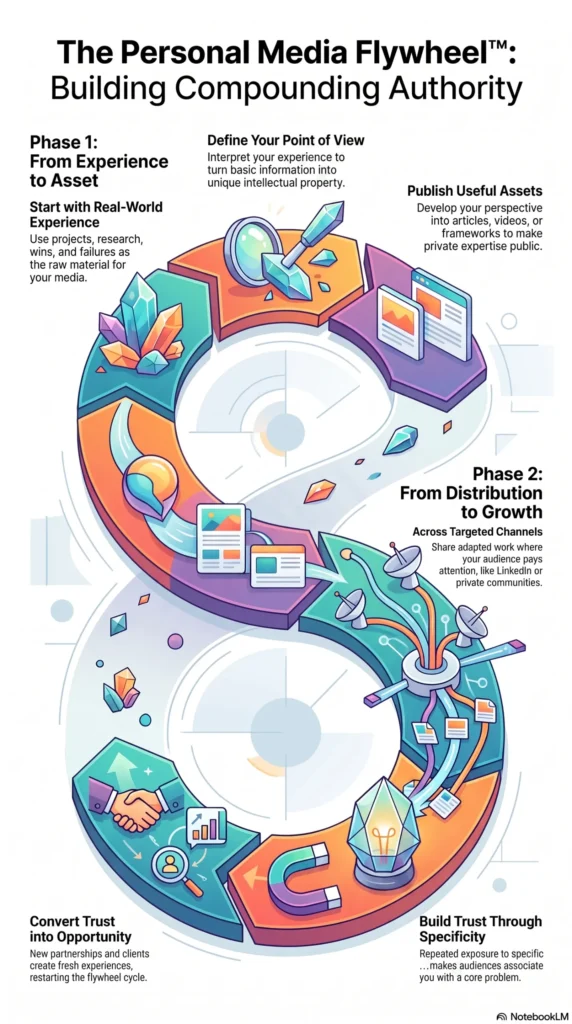
The Personal Media Flywheel
The Personal Media Flywheel is a six-stage framework for turning professional expertise into a compounding authority asset.
1. Experience
Everything begins with real work: customer conversations, projects, decisions, experiments, mistakes, research, wins, and failures. Media without experience quickly becomes generic commentary.
2. Point of view
Experience must be interpreted. What have you learned that others may not see? What does your market consistently misunderstand? Which accepted practice do you question? A point of view turns information into intellectual property.
3. Publishing
The point of view is developed into useful assets: articles, posts, newsletters, videos, talks, interviews, reports, frameworks, or case studies. Publishing makes private expertise public.
4. Distribution
The work is adapted and shared through the places where the right audience already pays attention. This might include LinkedIn, an owned website, email, YouTube, podcasts, industry publications, events, or private communities.
Do not automatically choose the most popular channel. First understand where your buyers discover expertise and make decisions, then choose the right distribution platforms for that behaviour.
5. Trust
Repeated exposure to useful, specific thinking builds familiarity and credibility. The audience begins to associate the person with a problem, category, or standard of expertise.
6. Opportunity
Trust generates conversations: clients, partnerships, invitations, talent, investment, press, speaking opportunities, or career options. Those opportunities create new experience, giving the person more useful material to publish.
The flywheel becomes:
Experience → Point of view → Publishing → Distribution → Trust → Opportunity.
Most people try to begin at publishing. They ask what they should post before identifying what their experience has taught them or what they want to be known for.
That is why so much professional content feels interchangeable.
Your audience is becoming a business asset
An audience is often dismissed as a vanity metric because follower counts can be inflated, irrelevant, or disconnected from commercial outcomes.
That criticism is valid when the wrong audience is being measured.
Ten thousand random followers may have very little value. Five hundred founders, investors, partners, buyers, or senior operators who repeatedly engage with your thinking can have considerable value.
A relevant audience gives an individual or business:
- Direct distribution without paying for every impression.
- Faster feedback on ideas, offers, and market language.
- A group of people already familiar with the person’s expertise.
- Greater resilience when algorithms, employers, or company priorities change.
- Warm introductions and opportunities that do not begin from zero.
- Branded search demand around the person and company.
- A body of public evidence that search engines and AI systems can discover.
The audience should not be treated as a substitute for expertise. It is the infrastructure through which expertise travels.
This is why a professional with both deep capability and trusted distribution can become unusually valuable. The company is not only hiring, partnering with, or buying from someone who knows how to do the work; it may also be gaining access to an existing conversation, reputation, and network.
The business case is trust, not reach
Founder-led marketing is often evaluated through impressions, reactions, and follower growth because those numbers are easy to see. But reach is only the outer layer of the system.
The more meaningful outcome is whether the founder’s public presence creates trust among the people who influence commercial decisions.
Useful signals include:
- Prospects mentioning specific content during sales conversations.
- More inbound messages from people who match the target audience.
- Increased branded searches for the founder or company.
- Invitations to speak, advise, partner, or contribute.
- Higher-quality candidates approaching the company.
- Existing clients sharing the founder’s content internally.
- Shorter explanations required during sales conversations.
- Buyers arriving with a clearer understanding of the company’s point of view.
- Citations or mentions in search engines, AI answers, newsletters, and industry publications.
This is where thought leadership creates value beyond awareness. LinkedIn’s research found that 47% of buyers visited a vendor’s website after engaging with creator content, while 38% said it prompted them to engage with a sales team.
The objective is not to become known by everyone.
It is to become known and trusted by the people who matter to your business.
How to build a founder-led media system
A sustainable system should not depend on daily inspiration or require the founder to spend half the week producing content.
Start with a simple operating rhythm.
Define one defensible point of view
Choose the market problem, belief, or category you want to become associated with. “Leadership,” “innovation,” and “growth” are too broad. A clear point of view should reveal how you interpret the market.
For example:
- Marketing becomes less effective when companies automate before understanding buyers.
- Professional-services firms lose trust when their online presence does not reflect their offline expertise.
- AI should elevate creative craft rather than standardize brands.
- Every founder needs a media system because expertise without distribution remains invisible.
Capture one substantive input each week
Use a customer conversation, client result, market observation, voice note, workshop, presentation, or internal debate. The best founder-led content usually begins with something that has actually happened.
Create one source asset
Develop the strongest idea into an article, newsletter, podcast, report, or video. This becomes the original source from which shorter pieces can be produced.
Distribute through a small ecosystem
Do not attempt to dominate every channel. Use one discovery platform and at least one owned platform.
For many B2B founders, that could be:
- LinkedIn for discovery and conversation.
- A website for search, permanence, and authority.
- Email for a direct relationship with the audience.
Use AI for production, not perspective
AI can transcribe conversations, identify themes, suggest structures, create variations, repurpose long-form work, and organize publishing workflows. It should not manufacture the point of view.
The founder supplies the experience, evidence, and judgment. AI helps the thinking travel further.
My detailed guide to AI tools for content creation explains how to build this workflow, while the Strawberry Test can help founders avoid generic AI-generated content that removes the very personality founder-led marketing depends on.
Measure trust signals
Track relevant audience growth, branded search, content-assisted conversations, inbound opportunities, newsletter subscriptions, referrals, and the ideas prospects repeat back to you.
The most important question is not:
How many people saw this?
It is:
Did the right people understand and remember what I want to be known for?
Does the company brand still matter?
Yes.
Founder-led marketing should strengthen the company brand, not replace it.
A company still needs independent credibility, clear positioning, proof, systems, customer relationships, intellectual property, and a reputation that can survive beyond one individual. Building the entire business around one personality creates concentration risk.
The stronger model is a people-powered brand.
The founder may be the first and most visible media channel, but over time, other executives, employees, customers, and experts can contribute. Their voices should not be forced into one identical corporate tone, but they should reinforce a shared strategic narrative from different perspectives.
The company becomes the institution.
The people become the trusted distribution network around it.
As the business grows, founder visibility should eventually feed a more structured startup growth system rather than remain a collection of disconnected posts and personal relationships.
The new professional advantage
We are not entering a world where expertise no longer matters.
We are entering a world where expertise and distribution are increasingly difficult to separate.
The strongest operators will still need to know how to build, advise, invest, sell, lead, analyze, and execute. But they will also need the ability to explain what they know, create trust around it, and make their ideas discoverable.
Communication is no longer a soft layer placed on top of the “real” work. For founders, consultants, executives, investors, and expert-led businesses, communication is part of how the work creates market value.
You do not need to become louder.
You need to become legible.
You do not need to document every moment of your life.
You need to build a body of work around what you know.
You do not need millions of followers.
You need a relevant audience that understands your perspective and trusts your judgment.
Everyone may not need to become an influencer.
But anyone whose business depends on expertise will increasingly need to operate like a media company.
If your firm’s best thinking remains trapped inside senior leaders’ heads, nova* can help turn that expertise into clear positioning, a repeatable publishing system, and a digital presence that makes the business easier to find, trust, and choose.
Explore nova*’s founder-led sales and GTM support or contact nova* to discuss the right starting point.
FAQ on Founder-Led Marketing: Become a Media Company
What is founder-led marketing?
Founder-led marketing is a strategy in which a founder becomes one of the primary public voices of the company. The founder shares expertise, insights, proof, and a clear point of view through content, conversations, events, and media to build awareness and trust around the business.
Why should founders become media companies?
Founders should operate like media companies because expertise needs distribution to create market influence. A personal media system helps founders publish their thinking, build a direct audience, establish authority, and create trust before prospects, investors, partners, or candidates contact the company.
Is founder-led marketing the same as personal branding?
No. Personal branding defines what the founder is known for and how the market perceives them. Founder-led marketing uses that reputation strategically to support the company’s visibility, trust, demand, recruiting, partnerships, or fundraising. A personal media system is the publishing and distribution infrastructure that supports both.
Do founders need a large audience for founder-led marketing to work?
No. Audience relevance matters more than audience size. A small audience containing the right buyers, investors, partners, operators, or industry influencers may create more commercial value than a much larger but poorly aligned following.
Does founder-led marketing replace the company brand?
It should not. Founder-led marketing humanizes and distributes the company’s expertise, while the company brand provides institutional credibility, proof, systems, and continuity. The strongest approach builds a company brand supported by several credible human voices.
How often should a founder publish content?
There is no universal publishing frequency. A sustainable starting point is one substantial source asset each month, supported by one or two shorter posts each week. Consistency, specificity, and relevance matter more than posting every day.
How can AI support founder-led marketing?
AI can help capture interviews, identify themes, structure articles, repurpose long-form content, create variations, and manage publishing workflows. The founder should remain responsible for the original experience, point of view, evidence, accuracy, and final judgment.
How do you measure founder-led marketing?
Useful measures include inbound enquiries from relevant prospects, branded search growth, newsletter subscriptions, speaking or partnership invitations, content mentioned in sales conversations, target-audience follower growth, referrals, and citations in search or AI answers. Impressions matter, but they should not be treated as the final commercial outcome.