



Ahlem Mahroua is the founder of nova*, a Marketing Advisory Studio helping founders and premium B2B firms become easier to find, trust, and choose. She has 20+ years of operator experience and has advised 400+ founders and enterprise boards across the GCC and Europe, including through Hub71, Sheraa, Plug and Play, and Techstars.
Connect with Ahlem Mahroua on LinkedIn.
Table of Contents
If you are scaling in 2026 and leading a growth-stage business right now, the pressure probably feels familiar.
Revenue needs to grow. Efficiency matters more than ever in the age of AI. The team is busy. The stack is getting heavier. The funnel is active.
And still, the business feels harder to control than it should.
That is the tension I keep seeing.
A lot of companies are growing in activity, but not in clarity.
They are adding:
- more channels,
- more tools,
- more reporting,
- more meetings,
- more handoffs,
- more people.
And it looks like progress. But very often, it is just complexity. And complexity has a cost.
I personally think that is one of the biggest scaling mistakes founders are making right now, because they are adding way too much before the system underneath is ready.
Growth and scale are not the same thing
We often use those two words as if they mean the same thing, but they don’t.
Growth can come from adding cost, adding people, and adding activity.
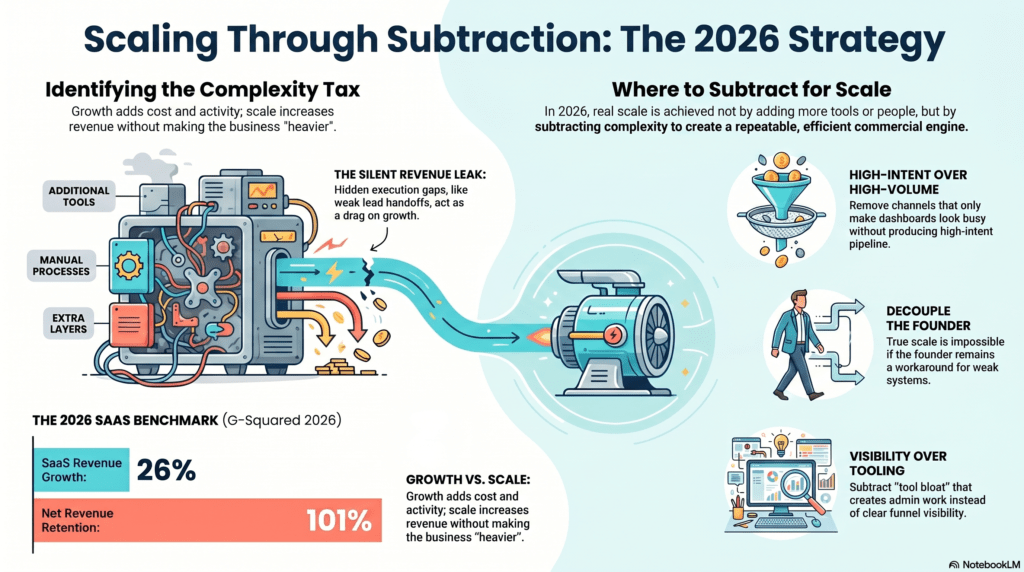
Scale is when revenue grows without the business getting heavier in all the wrong places. It is when the commercial engine becomes easier to repeat, easier to measure, and less dependent on heroic effort.
That is much harder. And the current market is not forgiving.
G-Squared’s 2026 SaaS benchmarks put median SaaS growth at 26% and median net revenue retention at 101%, which is a useful reminder that efficient growth is not easy, even in software.
So when founders tell me they want to scale, what I usually want to understand is this:
Are you actually scaling? Or are you just getting bigger, busier, and more complex?
Ahlem Mahroua, founder nova* growth studio
The real drag on growth is often hidden
One of the reasons this becomes hard to spot is that weak systems do not always fail loudly. From the outside, the company can look active: The team is moving, the CRM is full campaigns are live, deals are happening.
But underneath that, revenue can still be leaking in places nobody is managing closely enough.
That might look like:
- marketing generating leads sales does not trust
- sales pushing deals that are weakly qualified
- handoffs breaking between teams
- messy tool stacks that store information but do not create visibility
- founders stepping in too often to rescue important opportunities
A recent Forbes article makes a very similar point: missed revenue targets are often less about effort and more about hidden execution gaps across the commercial engine.
That is why I think the next scaling challenge for many founders is not “how do we add more?” It is:
What do we need to remove so the business can actually scale?
Ahlem Mahroua, founder nova* growth studio
My view: scaling in 2026 requires subtraction
This is the part I think matters most in 2026. Many founders are still trying to solve scaling problems by adding more top of funnel, more tools, or more people.
But if the commercial engine is already hard to see and hard to manage, that usually makes the problem worse. So the move is definitely subtraction / removal. Subtraction becomes a strategy. So what should you be removing from your growth engine:
- Complexity
- Weak channels
- Founder dependency
- Process clutter
- Useless tools
- Handoffs that nobody owns properly
This is what starts to create room for real scale.
Where subtraction matters most
In practice, I usually see three areas that need it most.
1. Too many channels, not enough signal
A lot of teams are still chasing volume they cannot properly convert. They are present everywhere, but not strong anywhere. So the first question is not always “how do we generate more demand?”
Sometimes it is:
- Which channels are actually producing high-intent pipeline?
- Which channels add low quality leads?
Not all growth is good growth. And not every lead source deserves to survive.
2. Too much founder dependency
Founder-led sales works very well early on. Because it’s fast, flexible and it really gets the business moving.
But if the founder is still the person translating the offer, clarifying the message, stepping into key deals, and compensating for weak follow-up, then the system is not really scaling.
It is leaning on the founder as a workaround. And maybe it will work for a while, but it doesn’t compound well over time.
3. Not enough visibility on the tools stack
This one is everywhere, from early stage to Series A growing fast. The company has tools, all the latest AI powered tools for dashboards, automation, reporting, CRM stages, attribution logic, leads generation, content creation…
And yet nobody can answer simple questions clearly:
- Where is the funnel leaking?
- Why are deals slowing down?
- Which message is actually converting?
- What does a good lead really look like?
- What is helping revenue move, and what is just creating admin?
At that point, the issue not a lack of tools, it’s a lack of system and growth clarity.
What founders and leaders should do before adding more
Before adding more spend, more SDRs, or more channels, I would want to understand:
- what the company is calling a good lead
- where the handoff between marketing and sales is weak
- where follow-up slows down
- what still depends too much on the founder
- whether the CRM reflects reality or just activity
- which parts of the system have become more complex than useful
That is where the real work starts. Not with “how do we do more?” But with “what is making scale harder than it needs to be?”
To me, that’s a much better question, as you can only remove what you can see and identify.
Final thought on scaling in 2026
I don’t think the companies that win in this market will be the ones doing the most. I think they will be the ones doing what matters with more precision.
And to me that means: clearer systems, cleaner handoffs between marketing and sales, better visibility, less founder dependency, and most of all less noise.
If growth and scale are starting to feel heavy, maybe the answer is not to add more. It’s to subtract what is making scale hard.
And in 2026, I think that is what smarter scaling looks like.
If this feels familiar, don’t start by adding more. Start by understanding where the system is already slowing growth down.
Learn more here
That is the role of the Revenue Architecture Diagnostic.
FAQ on The Science of Scaling in 2026: Why Removing Complexity Places You A Cut Above
What does scaling mean in 2026?
Scaling in 2026 means growing revenue without creating unnecessary complexity, cost, or founder dependency. It is about efficient growth, not just more activity.
What is the difference between growth and scale?
Growth can come from adding cost, people, and channels. Scale happens when revenue becomes more repeatable and the business gets more efficient as it grows.
What is GTM complexity?
GTM complexity is the extra friction created by too many tools, channels, handoffs, and processes inside the commercial engine.
Why does complexity slow down growth?
Because it reduces visibility, weakens accountability, creates inconsistent handoffs, and makes it harder to see where revenue is leaking.
What should founders review before adding more budget?
They should review lead quality, handoffs, follow-up speed, CRM visibility, founder dependency, and which channels are actually driving high-intent pipeline.