


Most startups don’t fail because of product.
They fail because their startup growth system breaks.
After working with founders across the UAE, Qatar, and Europe — through accelerators, venture programs, and advisory work — one pattern appears again and again:
A startup reaches $1M ARR.
Momentum looks strong.
Then growth slows, pipeline becomes unpredictable, and the team starts working twice as hard for half the results.
This is the moment where many startups believe they need:
- more ads
- more hires
- more marketing channels
But the real problem is usually much deeper.
The company never built a startup growth system.
The $1M ARR Illusion
The first million in revenue often comes from:
- founder networks
- early adopters
- opportunistic deals
- founder-led sales
This phase is chaotic, but it works because the founder is involved in almost every revenue decision.
The problem appears when startups try to scale that chaos.
What worked at $1M ARR rarely works at $5M.
And almost never works at $10M.
The Three Systems Every Scaling Startup Needs
Scaling companies don’t grow through tactics.
They grow through systems.
A sustainable startup growth system has three core components.
1. The Demand System
This system answers one question:
How does new demand consistently enter the company?
Many startups rely on:
- founder visibility
- partnerships
- word of mouth
Those channels are powerful, but they are rarely structured.
A proper demand system defines:
- ICP (ideal customer profile)
- messaging architecture
- content strategy
- acquisition channels
- lead capture infrastructure
Without this system, pipeline becomes unpredictable.
2. The Conversion System
Demand alone does not create revenue.
Conversion does.
This system ensures that:
- leads are qualified correctly
- sales conversations are structured
- customer objections are addressed
- deals move predictably through the funnel
Many startups lack:
- a defined sales process
- CRM discipline
- revenue analytics
As a result, they cannot diagnose where deals are lost.
3. The Revenue System
The final system focuses on long-term revenue expansion.
It includes:
- pricing strategy
- upsell opportunities
- retention programs
- customer success infrastructure
Startups that reach $10M ARR almost always build strong revenue systems.
Those that don’t remain stuck in constant acquisition mode.
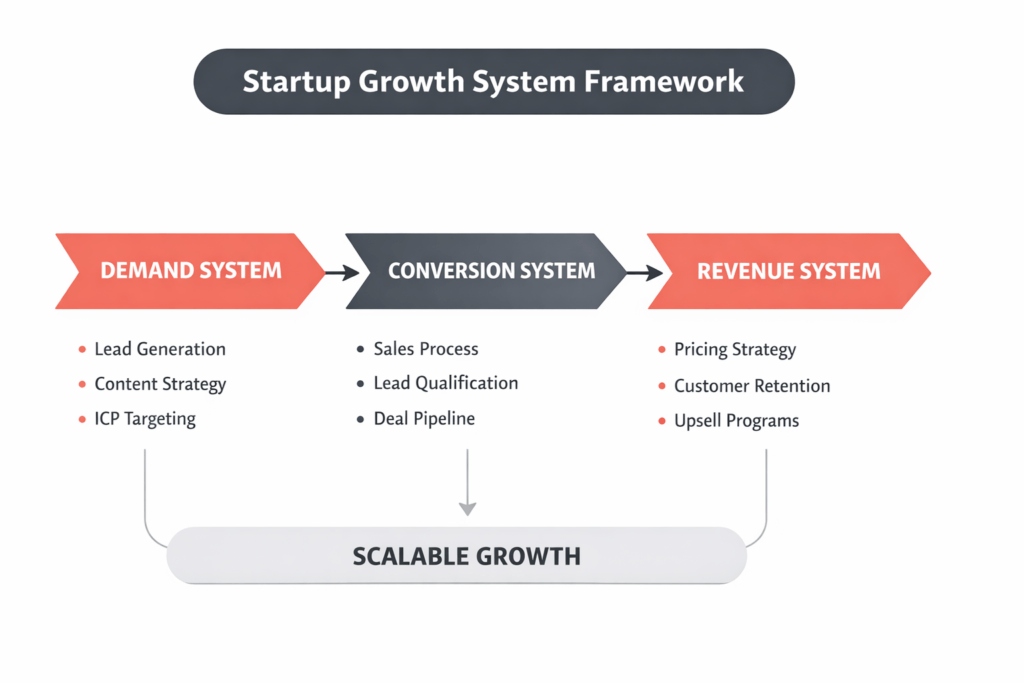
The Growth Architecture Model
Over time, I began describing startup growth through a simple framework.
Growth Architecture.
Growth architecture is the design of the three systems that power scale:
Demand System → Conversion System → Revenue System
When these systems are aligned, growth becomes predictable.
When they are not, founders experience what I call scaling chaos.
The Five Signs You Lack a Startup Growth System
If you are between $1M and $5M ARR, these signals are common:
- Pipeline fluctuates wildly month to month
- Sales relies heavily on the founder
- Marketing produces activity but not revenue
- Teams disagree on what drives growth
- Forecasting feels like guesswork
None of these are marketing problems.
They are system design problems.
Why Most Startups Try to Solve the Wrong Problem
When growth slows, the first reaction is often:
“Let’s increase marketing spend.”
But spending more on acquisition only amplifies existing weaknesses.
If your conversion system is broken, more leads simply means:
more leads lost.
This is why the most effective scaling companies focus on architecture before acceleration.
The Founder’s Diagnostic Checklist
If you want to understand whether your startup has a real growth system, ask yourself:
Demand
- Do we know exactly where our next 100 customers will come from?
- Are our acquisition channels repeatable?
Conversion
- Do we have a documented sales process?
- Can we identify exactly where deals stall?
Revenue
- Do we track expansion revenue and retention clearly?
- Is customer success tied directly to growth metrics?
If the answers are unclear, your company is likely operating without a structured growth system.
Growth Is Not a Tactic. It’s a System.
The difference between startups that plateau and those that reach $10M ARR is rarely talent.
It is rarely funding.
And it is almost never the product alone.
The real difference is architecture.
Companies that design their growth systems early unlock something powerful:
Predictability.
And predictability is the foundation of scale.
Final Thought
Most founders believe scaling requires more effort.
In reality, scaling requires better systems.
Because when the growth architecture is right:
- marketing becomes clearer
- sales becomes easier
- teams become aligned
- revenue becomes predictable
And the journey from $1M to $10M ARR becomes far less chaotic.
Ahlem Mahroua is the founder of nova*, a Growth Systems Studio helping startups design the architecture required to scale from $1M to $10M ARR.
Connect with Ahlem Mahroua on LinkedIn.
She has worked with founders across the GCC and Europe through leading accelerators including Hub71, Sheraa, Plug & Play, and Techstars.
Frequently Asked Questions
What is a startup growth system?
A startup growth system is the combination of demand generation, conversion processes, and revenue expansion mechanisms that allow a company to scale predictably.
Why do startups stall after $1M ARR?
Many startups rely on founder-led sales and opportunistic growth early on. Without structured demand, conversion, and revenue systems, growth becomes inconsistent.
What is growth architecture?
Growth architecture is the structured design of the systems that power sustainable startup growth.