



Ahlem Mahroua is the founder of nova*, a Marketing Advisory Studio helping founders and premium B2B firms become easier to find, trust, and choose. She has 20+ years of operator experience and has advised 400+ founders and enterprise boards across the GCC and Europe, including through Hub71, Sheraa, Plug and Play, and Techstars.
Connect with Ahlem Mahroua on LinkedIn.
Table of Contents – Fractional CMO Structure : Install Structure, Not Just Advice
There is a conversation I keep having with founders who are considering hiring a fractional CMO.
It usually sounds like this: “We need senior marketing leadership, but we’re not ready to hire full-time yet. So we’re looking for a fractional person who can come in, build our strategy, and help us scale.”
That makes sense on the surface. But here’s what I’ve learned: most founders don’t actually have a “fractional CMO problem.” They have an unstructured marketing problem.
There is activity. Campaigns are running. Content is going out. Leads are coming in. People are having meetings. But somehow, the founder is still holding the whole commercial system together. They’re still deciding priorities. Still reviewing important work. Still fixing handoffs. Still explaining the buyer. Still asking why marketing and sales aren’t aligned.
That’s not leverage. That’s an expensive bottleneck wearing a new title.
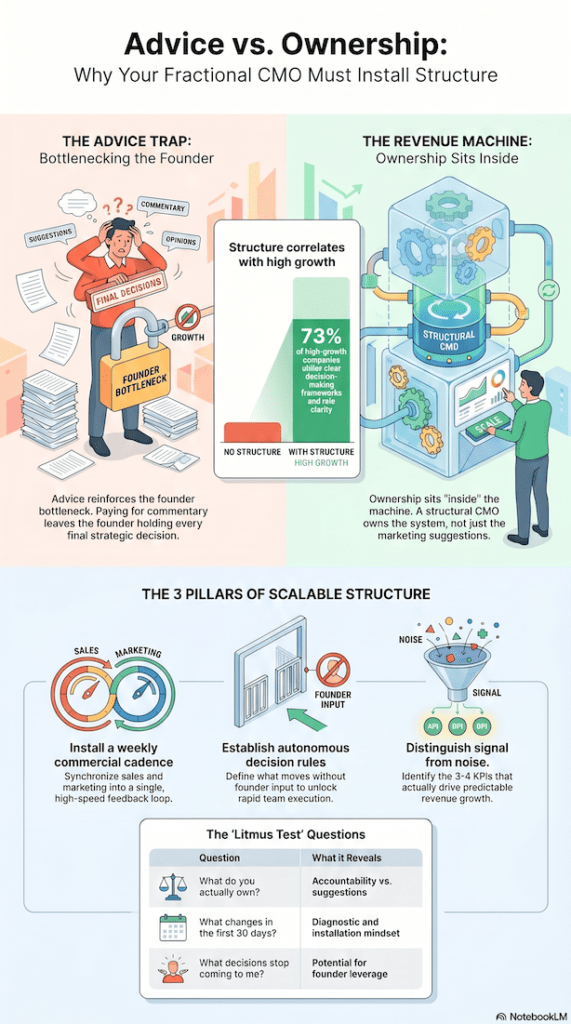
A real fractional CMO shouldn’t just give you marketing advice. They should help you install the structure that lets the business run better without everything routing back through you. Because that’s the difference between hiring an advisor and hiring a revenue leader.
Ahlem Mahroua, founder nova* growth studio
The Advice vs. Control Problem
Most fractional relationships fail for one reason: they start with advice, not ownership.
A founder brings someone in to:
- Comment on campaigns
- Share suggestions on messaging
- Join important calls
- Review quarterly strategy
- Then leave the founder holding all the real decisions
That’s not unusual. That’s how a lot of fractional engagements actually work. And it feels senior. It feels professional. It even feels like you’re hiring leadership.
But it doesn’t remove the bottleneck. It just makes it more expensive.
Because if the founder is still the person deciding priorities, resolving handoffs, keeping the commercial picture together, and reviewing every important move—then nothing has actually changed. The work just got more expensive. And the founder is now waiting for feedback instead of moving forward.
That’s why I think there’s a real distinction founders need to understand: the difference between someone who advises on marketing and someone who owns the marketing system.
One sits on the side and comments. The other sits inside the machine.
Why This Distinction Matters More Than You Think
Let me be direct about the cost of this confusion.
When you hire a fractional CMO for advice, you’re paying for:
- Time in meetings
- Commentary on work
- Input on strategy
- But still: your decision-making, your prioritisation, your bottleneck
When you hire a fractional CMO to install structure, you’re paying for:
- Clarity on what KPIs actually matter
- A weekly operating cadence between marketing and sales
- Funnel logic that makes revenue predictable
- Clear team priorities
- Decision rules so things move without founder input
Those are not the same service. And they cost very different amounts of founder attention.
In my experience working with founders scaling from $1M to $10M ARR, founder dependency is one of the biggest brakes on commercial growth. Not because the founder is bad at decisions. Because good founders tend to have good instincts, so everything routes back to them.
That works early. But it doesn’t scale.
A study by McKinsey in 2025 found that 73% of high-growth companies had clear decision-making frameworks and role clarity, while only 41% of slower-growth companies did. That gap matters. Because clarity allows execution to move faster. And faster execution means faster growth.
So when a fractional CMO just advises, they’re actually reinforcing the bottleneck. They’re adding senior judgment without removing founder dependency.
What “Owning the Machine” Actually Means
When I was CMO at my previous organization, I wasn’t sitting on the side advising. I owned the machine. And that meant owning both marketing and sales KPIs, structuring the CRM properly, training teams on buying signals, managing internal teams and external agencies, owning budgets, and making sure the whole revenue engine moved in one direction.
That’s what real revenue leadership looks like.
A strong fractional CMO should bring that same ownership mindset, scaled to the scope of your business. Not managing every detail, but owning the system.
And that means bringing structure to five specific things:
1. The KPIs that actually matter
Most growing companies have too many metrics. Pipeline velocity, lead quality, cost per acquisition, conversion rates, content engagement, website traffic, MQL to SQL conversion, sales cycle length, deal size, win rate.
All of those are data points. But they’re not all KPIs. A good fractional CMO helps you distinguish between the noise and the signal. What are the 3-4 metrics that actually drive revenue? What is marketing really accountable for? Which metrics should move sales and marketing forward together?
That clarity changes how your team operates. And it changes fast.
2. The weekly cadence between marketing and sales
This one is invisible until it’s broken. Most growing companies have marketing doing their thing and sales doing theirs. They share a CRM. They have a monthly meeting. But they don’t really operate as one commercial system.
A real fractional CMO installs a weekly rhythm: what did marketing generate last week, what quality was it, where did it leak, what do we need to adjust. That rhythm creates feedback loops. It creates accountability. It creates speed.
Without it, marketing and sales stay siloed. With it, they become one system.
3. The funnel logic behind how revenue moves
Most founders can describe their product really well. But they struggle to describe how a buyer actually moves through their funnel. What does a qualified lead really look like? At what point do we know they’re a real opportunity? Where do deals usually stall? Why do some close fast and others drag?
That’s funnel logic. And it’s the foundation of a repeatable revenue system. A good fractional CMO helps you map that. Clearly. Specifically. So that everyone—marketing, sales, the founder—is working from the same picture of how revenue actually flows.
4. The team’s priorities (and what stays with the founder)
This is huge. Most teams don’t know what they should be saying no to. So they say yes to everything. Content, campaigns, events, partnerships, new channels, feature requests, special projects.
A fractional CMO creates a priority framework. What are we actually trying to do this quarter? What does success look like? What gets resources, and what doesn’t? What can the team do without founder input?
Clarity on priorities actually frees up founder time more than anything else.
5. The decision rules for what needs founder input and what doesn’t
Finally: what decisions actually need the founder? Not all of them. A lot of growing companies treat the founder like the approval layer on everything. Campaigns need founder sign-off. Messaging changes need founder sign-off. New tools need founder approval.
That’s not necessary. A good fractional CMO structure helps you establish clear decision rules: messaging decisions move with marketing and sales alignment. Campaign tactics move if they fit the strategy. New tools move if they improve the core KPIs. The founder gets pulled in only on decisions that reshape the commercial strategy or require founder authority.
That changes everything. The team moves faster. The founder breathes. And decisions don’t stack up waiting for input.
How to Evaluate a Real Fractional CMO
So here’s the filter I would use before hiring anyone fractional. These are the questions that separate advisors from revenue leaders:
1. What do you actually own?
Not: what do you advise on? Own. It’s different. Ask them what they’re responsible for. What metrics do they care about? What happens if those metrics don’t move? If the answer is vague, the role is probably vague too.
2. What do you change in the first 30 days?
A real leader comes in to diagnose, then install. Ask them: what will you look at first? What are the first things you’ll fix? What should improve in your first month? If they say “I’ll build relationships and understand the business,” that’s not wrong. But it should be paired with: “And then I’m going to change X, Y, and Z.”
3. How do you align sales and marketing?
This is the litmus test. Sales and marketing misalignment is one of the biggest leaks in most growing companies. Ask them specifically: how do you make sales and marketing operate as one system? If the answer is “we’ll have better communication,” that’s not enough. You need structure. Weekly cadence. Shared metrics. Funnel clarity.
4. What decisions stop coming back to you?
Ask them: what decisions will move without founder input? How many decisions are we removing from the founder in the first 90 days? If they can’t answer that specifically, they’re probably going to keep you in the loop on everything.
Those four questions will tell you a lot. If the answers are vague, the role is probably vague. And vague roles create disappointed founders.
Why This Matters in 2026
Founders are under more pressure than ever. Growth expectations are high. Capital is tighter. The market is moving fast.
And in that environment, every hire matters. Every dollar spent on overhead needs to deliver something real.
So when you’re considering a fractional CMO, don’t ask: “Will they make us better at marketing?” That’s table stakes.
Ask: “Will they remove founder dependency from our commercial system? Will they install structure that lets us move faster without me reviewing everything? Will they own the revenue engine instead of advising on the side?”
Because that’s the only fractional CMO hire that actually creates leverage.
Advice scales a little. Structure scales a lot. And in 2026, founders need leverage more than they need another person in the room offering opinions.
What to Do Next
If your company is growing but your commercial system still feels dependent on founder instinct, inconsistent handoffs, or unclear funnel visibility, that’s usually the moment to bring in senior leadership to diagnose and build the structure.
That’s exactly what I do through my Revenue Architecture Diagnostic and Fractional Revenue Architecture Advisory service.
Learn more about fractional revenue architecture advisory here
The diagnostic helps you see where the bottlenecks actually are. The advisory helps you install the structure to remove them.
FAQ on Fractional CMO: Install Structure, Not Just Advice
What’s the difference between a fractional CMO who advises and one who installs structure?
An advisor sits on the side, comments on campaigns, and gives input on strategy. A structure-builder owns the revenue system—they’re responsible for clarity on KPIs, sales and marketing alignment, funnel logic, team priorities, and decision rules. One keeps the founder in the loop. The other removes the founder from unnecessary decisions.
How do I know if my fractional CMO is really owning the system?
Watch what happens in your first 90 days. Are decisions moving faster? Are fewer things coming back to you for approval? Can your team answer basic questions about the funnel without calling you? Is there a weekly rhythm between marketing and sales? If not, they’re probably advising, not owning.
Isn’t founder involvement good? Don’t I want oversight?
Yes, but there’s a difference between oversight and bottleneck. You should be involved in decisions that reshape strategy or require founder authority. But most operational decisions—campaign approvals, messaging variations, tool implementations—should move through the team with clear decision rules. That’s how you create leverage.
What does “owning the KPIs” actually mean for a fractional CMO?
It means they’re accountable for certain metrics moving. Not just reporting them, but actually responsible for the strategy, the team alignment, the process changes needed to improve them. If pipeline velocity is a KPI you own together, they should be looking at every factor affecting it—not just marketing’s contribution.
How long does it take to install this kind of structure?
The first 30 days should be diagnosis—understanding your current system, where the gaps are, and what needs to change. The next 60-90 days should be installation—putting the KPIs in place, establishing the weekly cadence, clarifying the funnel, setting decision rules. Real changes should be visible in the first 90 days.
Should the fractional CMO manage my team or just advise them?
That depends on your structure, but real ownership usually means some level of direction-setting and alignment-building with your team. They might not be their day-to-day manager, but they should be clear about what the team is accountable for and what success looks like. Without that clarity, the team can’t really execute on the strategy.
What if my company is still early? Is a fractional CMO who installs structure premature?
If you’re still in founder-led sales and haven’t found repeatable channels yet, you might not be ready. But if you’re at $1M+ ARR and you have both marketing and sales happening, you’re probably at the stage where structure starts creating real value. The question isn’t whether you’re ready for a CMO. It’s whether you’re ready for someone to actually own the system instead of advising.